
Meet Green Hydrogen, the fuel of the future

Concern for the environment and awareness of the importance of preserving it encourage the emergence of new technologies that aim to minimize the negative impact caused by human activity on the planet.
One of these innovations is Green Hydrogen, a potentially beneficial alternative fuel for combating the climate changes that today afflict the planet, in addition to being a key piece for decarbonization.
If you want to understand exactly what Green Hydrogen is, how it is obtained and what to expect from this new technology, keep reading!
What is Green Hydrogen?
Green Hydrogen, H₂V, is a fuel produced from renewable sources, such as wind, solar or hydro. The technology is already in use in some countries in the Middle East, Europe and North America and many of the optimizations for its production are still under development.
The product can be obtained through water electrolysis. By applying an electric current in a controlled environment, the hydrogen contained in the water is separated for later use.
One of the main advantages of Green Hydrogen compared to other fossil fuels is that it does not emit carbon dioxide when burned. Instead, the only by‑product of the reaction is water vapor, which is not harmful to the environment. However, to be considered green, it is essential that the energy source used in the process be renewable, particularly hydro, wind or solar.
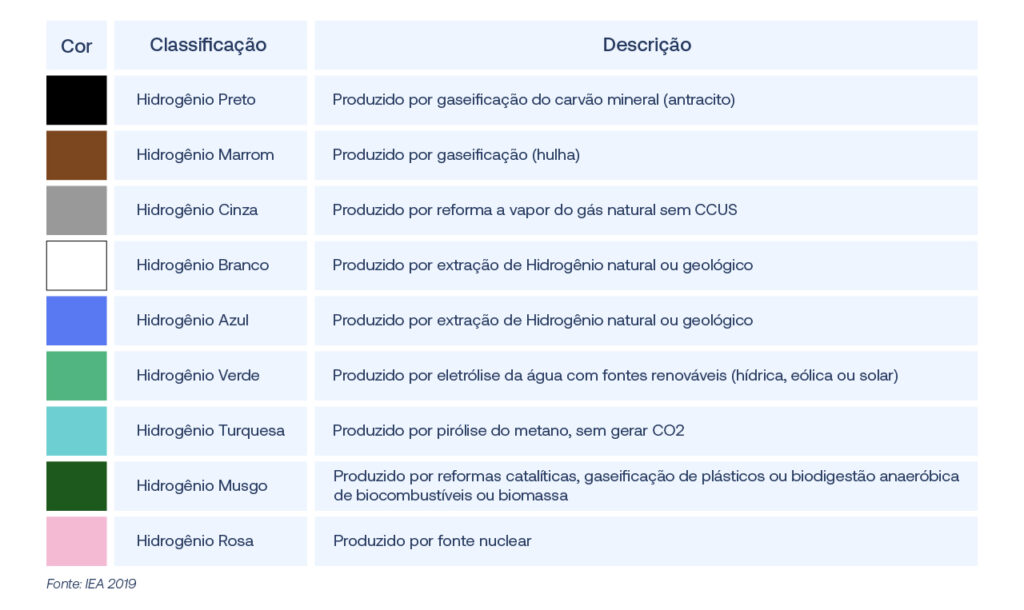
The production of hydrogen as a fuel through other energy sources involves several other color classifications, as shown below:
What are the possible uses for Green Hydrogen?
Green Hydrogen can be used as fuel for cars, airplanes, boats, trains or any other vehicle, land or air. It can also be used to generate energy, serving as fuel for mobility, industrial processes and heating, replacing gas in various processes.
For example, ammonia production plants that currently use fossil fuels have already begun to structure the replacement of the fuel with H₂.
In addition to the environmental issue, economics is another important factor when it comes to the potential of Green Hydrogen. This is because currently Green Hydrogen is a very expensive product. It was introduced on the global agenda with the goal of technological evolution, scale gains and increased economic viability.
Only when it becomes truly economically viable will it start replacing other fuels.
What will be the main advantages of using Green Hydrogen?
In summary, the main advantages of Green Hydrogen will be:
100% sustainable: does not emit carbon dioxide into the environment;
Possibility of storing the product, H₂, for future use;
Versatility, since Green Hydrogen can form different products with various applications;
Potential contribution to energy security. Hydrogen can serve as an energy source during supply crises. An example is Europe, which, amid a gas supply crisis from Russia, is already implementing H₂ for heating in winter.
Are there disadvantages to using Green Hydrogen?
Since it is still a relatively unexplored technology, the cost of its operations is still high. But as there is greater utilization and incentive for the application of Green Hydrogen, it is likely that, in the not‑too‑distant future, it will become economically viable.
What is the impact of Green Hydrogen for companies?
It is still early to say what the impact of Green Hydrogen will be when it is widely used in companies and energy generators.
However, it is expected to be positive, since Green Hydrogen can minimize dependence (or even replace the use) of fossil fuels and reduce carbon dioxide emissions into the atmosphere.
What is Brazil's potential in Green Hydrogen production?
Brazil can become a green powerhouse in the coming years and one of the major producers of Green Hydrogen, a factor of great strategic importance.
Moreover, the country stands out as an energy powerhouse, with a predominantly clean electricity matrix, being able to position itself as a country that can help Europe in decarbonization with Green Hydrogen.
Above all, countries that have abundant water and renewable energy production, which are inputs for Green Hydrogen production, have high potential to become references in its production. Brazil has both inputs in abundance, potentially being one of the main players in the production of this fuel.
What is the importance of Green Hydrogen for the energy transition?
The energy transition is the process by which an economy moves from an energy system based on non‑renewable energy sources, such as oil and coal, to an energy system based on renewable sources, such as wind and solar. It is a necessary movement to reduce greenhouse gas emissions and mitigate the impacts of global warming.
With this in mind, many companies have carried out their transition with the help of renewable energy sources, acquiring energy resource packages directly from clean energy producers, something made possible by the Free Energy Market.
As Green Hydrogen becomes more prevalent, this transition tends to accelerate, since generators will have more means to produce energy for companies, lowering the cost and making energy accessible. All this without harming the environment.
In this way, it can be concluded that Green Hydrogen is a trend that promises to revolutionize how energy is consumed and stored. You have seen that, despite being a new technology, it is extremely promising given the global climate scenario and the need for the energy transition.
Want to learn more about how your company can be sustainable? Understand how clean energy is advantageous for your company and the environment with Serena!

Redação Serena Energia
We are part of Serena, one of the country's leading generators and traders of clean energy, with 15 years of experience connecting people and businesses to sustainable and competitive solutions. Here on the blog, you'll find content on the electricity sector, Free Energy Market, sustainability, and energy transition, with clear explanations to support decisions in your daily life, whether at home or in your business.
Editor
Leave a comment
Your email address will not be published. Required fields are marked with *