
Captive consumer and free consumer: Understand the differences

When researching the Free Energy Market you come across the segmentation of the Brazilian energy sector into ACR (Regulated Contracting Environment) and ACL (Free Contracting Environment).
In this context, there are two types of energy buyers: the Captive Consumer and the Free Consumer, which have some differences between them. Want to know what they are, in addition to the advantages of the Free Energy Market? Check out this article!
First, what is the Free Energy Market?
Understanding what a Captive Consumer and a Free Consumer are involves the concept of the Free Energy Market. If this terminology is new to you, don’t worry, we’ll explain.
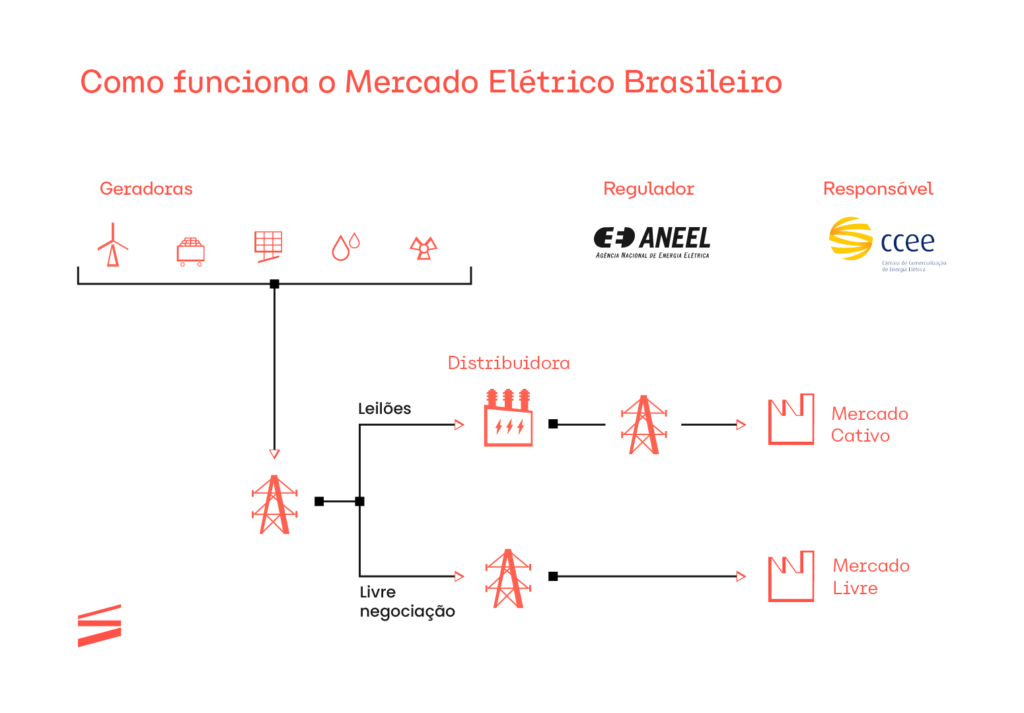
In the Regulated Contracting Environment (ACR), also known as the Captive Market, only the distributor buys energy and does so through auctions. In this way, end‑consumers (captive) pay a tariff for the energy consumed during the month, added to the other tariffs regulated by ANEEL (National Electric Energy Agency).
This is the reality for most Brazilians who cannot choose from whom to contract energy and end up restricted to the local utility.
In the Free Energy Market it is different: the Free Consumer negotiates with traders and generators in the Free Contracting Environment. Thus, conditions such as price, term and supply are established in bilateral commercial contracts, tailored to the company’s needs.
As you can imagine, prices tend to be more attractive in the Free Energy Market, since the negotiation happens directly with the trader or the generator, in a competitive environment.
Captive Consumer and Free Consumer: what’s the difference?
The Captive Consumer is someone who does not have the option to choose their own energy supplier. They also cannot negotiate the price. They pay a bill every month to the local energy utility and are subject to government‑regulated tariffs.
On the other hand, the Free Consumer has the possibility to choose which generating or trading company to purchase energy from, contracting directly. With this, they have the freedom to negotiate all commercial conditions, such as energy volume, price, supply period, and even contractual flexibility aspects.
Captive Consumer and Free Consumer: advantages of the Free Market
Now that you understand what the Free Energy Market is, the difference between Captive Consumer and Free Consumer should also be clearer. But, before presenting the advantages and disadvantages of each, it is important to explain an important factor.
For now, only a Free Consumer can have a contracted demand of at least 500 kW. In other words, only industrial facilities and medium‑ and large‑size companies fall into this profile.
Units with the same CNPJ root can also sum their respective demands to reach the minimum 500 kW, provided each has at least 30 kW of demand and all belong to the same sub‑market.
Captive Consumer
Disadvantages
What can be an advantage sometimes also becomes a disadvantage. In the case of Captive Consumers, this passive relationship with energy, considered practical because it only involves paying a monthly bill, can significantly increase their costs.
This is one of the main disadvantages of the Captive Consumer, because since they cannot negotiate their energy in advance and sign contracts suited to their business, they end up paying the current tariff rate.
Another disadvantage that impacts high‑voltage customers is the higher energy tariffs during peak hours, when the greatest consumption peak occurs. Each distributor has three pre‑defined hours for this charge, and the energy consumed during that period costs, on average, 60% more.
In addition, the Captive Consumer is subject to tariff flag charges and may pay surcharges on the bill according to the conditions of electricity generation. That is, if a drought occurs and the hydroelectric reservoir levels drop, the Captive Consumer will pay a higher bill due to the high price of electricity generation.
Free Consumer
Advantages
The main advantages of the Free Consumer are derived from their freedom of contractual negotiation. They can choose from whom to buy energy (traders or generators), agree on price, the volume needed, the supply period, delivery flexibility, the financial guarantee of the contract, the payment date, and even the energy source.
With all these possibilities, they participate in a competitive market and thus enjoy more attractive prices. They also gain predictability in their budget, since the contract allows them to estimate the amount to be paid, without the risk of a future increase, as happens in the Captive Market.
With this predictability, the Free Consumer also does not need to worry about tariff flags, nor about the higher energy tariff during peak hours, because the price to be paid is set beforehand, in the contract, and does not follow the market’s ups and downs.
Can a Captive Consumer become a Free Consumer?
There are prospects that the minimum demand will be reduced in the coming years, allowing smaller companies and even residential consumers to migrate to the Free Energy Market. A Bill is pending vote in the Chamber of Deputies and the Senate to amend the electric sector’s regulatory framework, creating electricity‑bill portability, as already happens in the telecommunications sector, for example.

Redação Serena Energia
We are part of Serena, one of the country's leading generators and traders of clean energy, with 15 years of experience connecting people and businesses to sustainable and competitive solutions. Here on the blog, you'll find content on the electricity sector, Free Energy Market, sustainability, and energy transition, with clear explanations to support decisions in your daily life, whether at home or in your business.
Editor
Leave a comment
Your email address will not be published. Required fields are marked with *