
Difference between free and regulated energy market ACL
Written by: André Lima, Growth, Serena Energia
Key takeaways from this article
-
The regulated market applies tariffs defined by ANEEL and subject to tariff flags, while the free energy market allows contracts with fixed price and greater financial predictability.
-
Any Group A company, with medium or high voltage supply, can migrate to the free energy market, regardless of consumption volume, provided it conducts an eligibility analysis.
-
The migration follows seven structured steps, which include registration with CCEE (Electric Energy Commercialization Chamber), choosing a reliable retailer, and installing hourly metering.
-
Long‑term contracting with partners that have their own generation, such as Serena Energia, reduces short‑term price risk, counter‑party risk, and liquidity risk in the free energy market.
-
Companies seeking cost savings, sustainability and specialized management can count on Serena Energia. Talk to a consultant.
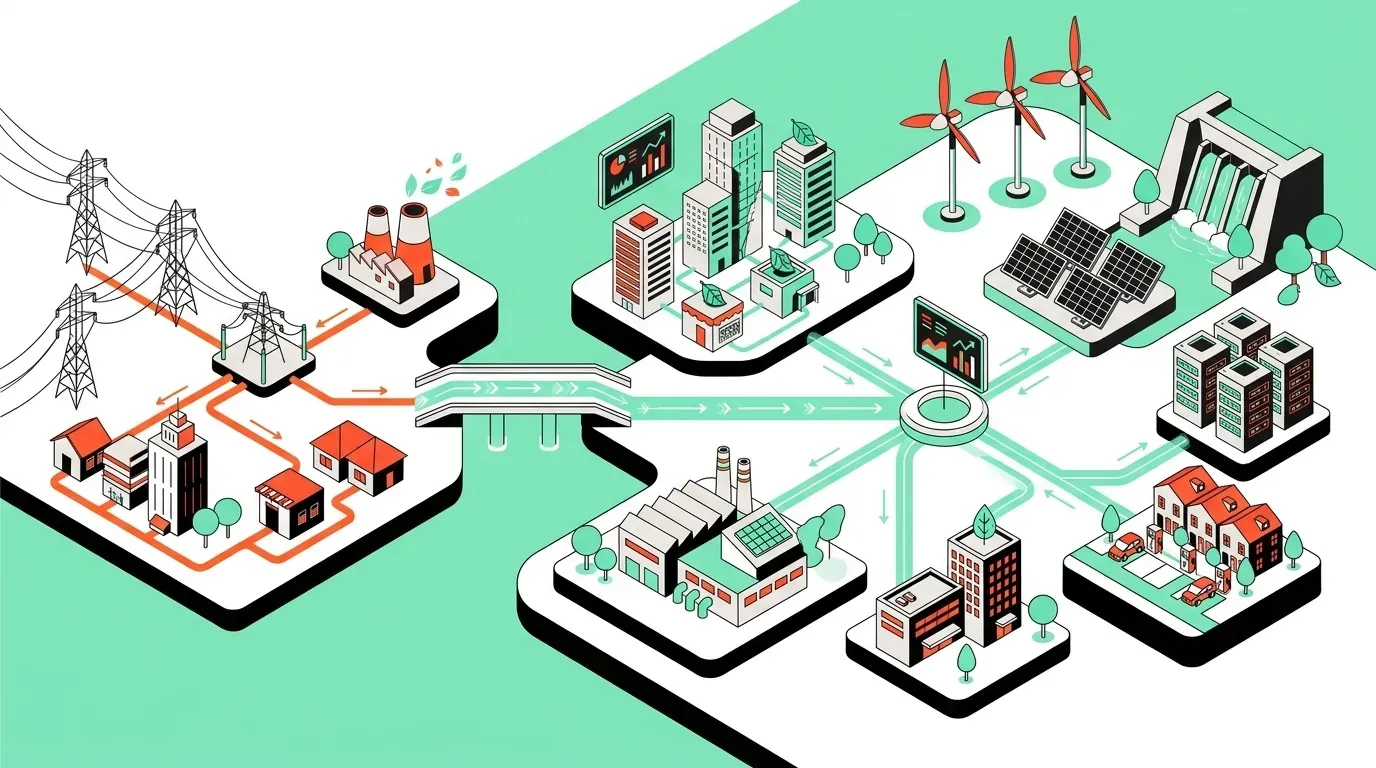
Comparative table: free energy market (ACL) vs regulated market (ACR)
|
Criterion |
Free energy market (ACL) |
Regulated market (ACR) |
|---|---|---|
|
Price |
Negotiated in a bilateral contract with fixed price for the agreed period |
Defined by ANEEL, subject to annual adjustments and tariff flags |
|
Flexibility |
Company negotiates volume, term and conditions with the chosen supplier |
No negotiation autonomy, with conditions imposed by the local distributor |
|
Supplier choice |
Possibility to choose among retailers and generators authorized in CCEE (Electric Energy Commercialization Chamber) |
Exclusive supply by the local regional distributor |
|
Source of energy |
Possibility to contract 100% renewable energy with I-REC certification |
Grid mix without source traceability for the consumer |
In both markets, the local distributor remains responsible for the physical delivery of electricity to the consumer unit. The difference lies in who sets the price and the supply conditions.
Who can migrate to the free energy market?
Any company connected at high or medium voltage, classified as Group A, can migrate to the free energy market, regardless of monthly consumption volume. There is no minimum consumption, as long as the consumer unit is classified in Group A.
When a single unit does not meet the technical voltage requirements, the company can assess load sharing with other units of the same economic group. Serena Energia conducts the eligibility analysis at no cost to the interested company.
How to migrate to the free energy market in 7 steps
Step 1: verify the company's eligibility
The first step is to confirm whether the consumer unit is in Group A, with medium or high voltage supply. Once technical eligibility is confirmed, the company should analyze the invoices from the last 12 months to map the consumption pattern and contracted demand, information that guides the sizing of the contract in the free energy market.
Step 2: analyze the consumption profile
Mapping monthly consumption in kWh reveals seasonality and demand peaks. This analysis guides the choice of contract type, defines the volume to contract and indicates the potential savings in the free energy market.
Step 3: choose a reliable retailer
Choosing the commercial partner defines the level of migration security. The company should assess financial solidity, its own generation backing, operational history, and continuous management capability.
Serena Energia is among the largest wind and solar power generators created in the Americas, with over 17 years of history and its own generation that underpins every contract signed.

Request your feasibility study allows you to receive a detailed and personalized analysis for your company.
Step 4: register the company with CCEE (Electric Energy Commercialization Chamber)
Registration with CCEE is mandatory to participate in the free energy market and requires technical, legal and financial documentation. Serena Energia conducts the entire process at no additional cost to the client.
Step 5: negotiate and close the energy contract
Contracts in the free energy market usually have a duration of 3 to 5 years, with a fixed price agreed in advance. Serena Energia structures contracts that aim for savings compared to the regulated market and fit the company's consumption profile.
Step 6: implement the measurement system
Hourly metering is mandatory in the free energy market. Serena Energia is responsible for installing measurement equipment compatible with CCEE rules, also at no additional cost to the client.
Step 7: monitor and adjust consumption monthly
After entering the free energy market, which occurs six months after the start of the process, Serena Energia represents the company before CCEE, manages sectoral obligations and provides a digital dashboard with monitoring of monthly savings, actual consumption and consumption forecast.
The client has a dedicated consultant for continuous performance monitoring and to propose contractual adjustments when necessary.
Real migration risks and how Serena Energia mitigates each
The free energy market scenario in 2026 presents concrete challenges that need to be evaluated before migration.
-
Short‑term price pressure: short‑term contracts in the free energy market saw a 121% increase between January 2024 and March 2026, while long‑term contracts, with a four‑year duration, rose 59% in the same period. Companies that contract long‑term reduce exposure to short‑term market fluctuations.
-
Counter‑party risk: the market recorded financial difficulties among retailers, with renegotiations and judicial recoveries. Choosing a partner with its own generation and proven financial solidity is the main mitigation factor.
-
Reduced liquidity: industry associations identified a critical liquidity constraint in 2026, with limited supply of medium and long‑term contracts. Partners with their own generation backing have greater capacity to honor contracts even in scarcity scenarios.
-
Exposure to the short‑term market: consumption outside the contracted range is settled by the PLD (Price of Settlement of Differences). The PLD intraday showed greater variation in 2026 compared to 2023. Active consumption management by Serena Energia reduces this exposure.
Serena Energia mitigates these risks with its own generation that underpins each signed contract, active monthly management with CCEE and over 17 years of continuous operation with large‑scale clients such as Heineken, Cargill and Bayer. Industry experts indicate that the current crisis is cyclical and that partners with pre‑contracted physical backing and rigorous counter‑party diligence tend to be more resilient.

Proven sustainability: I-RECs and carbon credits with Serena Energia
ESG managers and sustainability directors need to consider the source of energy with the same weight as cost. The I-REC (International Renewable Energy Certificate) is the international certificate that audibly proves that 1 MWh of electricity was generated from a renewable source and injected into the grid. In Brazil, the I-REC program operates with the Totum Institute as the authorized issuer under an international standard, with independent audits and global traceability.
This auditable certification becomes a strategic asset for the company. By contracting energy with Serena Energia, the company receives I-RECs corresponding to its consumption, which allows formally declaring that its electricity consumption is 100% renewable, essential information for sustainability reports, Scope 2 decarbonization targets and stakeholder and investor requirements.

I-RECs are increasingly used in environmental audits, commercial contracts and brand institutional positioning. Since 2017, Serena Energia has avoided the emission of more than 2.14 million tonnes of CO₂. For companies that aim to go beyond Scope 2 emissions, Serena Energia also offers carbon credits from certified projects to neutralize other emission sources.

Structure your renewable energy strategy
ável with globally recognized I-REC certification strengthens the company's sustainability agenda.Frequently Asked Questions about Migration to the Free Energy Market
Can my company migrate to the free energy market?
Any company connected at medium or high voltage, classified as Group A, can migrate to the free energy market, regardless of monthly consumption volume. There is no minimum consumption.
When a unit does not meet the voltage requirements, the company can assess load sharing with other units of the same economic group. Serena Energia conducts the eligibility analysis at no cost.
How long does the migration process take?
The regulatory process takes six months, counted from the formal notification to the local distributor. This period corresponds to the termination of the existing contract with the distributor.
During this period, Serena Energia conducts all steps, which include registration with CCEE, measurement system adaptation, and contractual formalization, at no additional cost to the client. The sooner the company starts the process, the sooner it begins to save.
What happens if my company consumes more or less energy than contracted?
Contracts in the free energy market provide a flexibility band for consumption variations. Differences outside this band are settled in the short‑term market by the PLD (Settlement Price of Differences).
Serena Energia performs active monthly consumption management, helps the company forecast its usage profile, and works to reduce exposure to the short‑term market.
Does migration to the free energy market interrupt energy supply?
Migration does not interrupt energy supply. The process is commercial and contractual, and the local distributor remains responsible for the physical delivery of electricity to the consumer unit, maintaining grid quality and stability.
The only change is the energy supplier. After migration, the client receives two invoices, one for energy from Serena Energia and another for distribution from the local distributor, with Serena Energia centralizing the management of both.
Is I-REC internationally recognized for ESG reporting?
The I-REC (International Renewable Energy Certificate) is a globally recognized certificate used in sustainability reports, environmental audits, decarbonization targets, and contractual requirements of clients and investors.
In Brazil, issuance is performed by an authorized issuer under international standards, with traceability of the energy from the generating source to the final consumer. Serena Energia issues I-RECs corresponding to each client's consumption, enabling a formal declaration of 100% renewable consumption.
Conclusion: Your company now has clarity to decide
The difference between the free energy market and the regulated market centers on autonomy, predictability, and energy source. In the Regulated Market (ACR), tariffs are set externally, with adjustments and tariff flags that hinder financial planning. In the Free Market (ACL), the company negotiates price, term, and source with the supplier of its choice, while the local distributor retains responsibility for the physical delivery of electricity.
Serena Energia offers end‑to‑end managed migration, with feasibility analysis, registration with CCEE, measurement system adaptation, and continuous monthly management, at no additional cost for companies under its management. With its own wind energy generation, over 17 years of operation, and the previously mentioned environmental impact, Serena Energia combines financial solidity, physical backing, and technical expertise to be your company's energy partner in the free energy market.
Transform your energy cost into a competitive advantage with the managed migration by Serena Energia is the next step toward more strategic energy management.

André Lima
We are part of Serena, one of the country's leading generators and traders of clean energy, with 15 years of experience connecting people and businesses to sustainable and competitive solutions. Here on the blog, you'll find content on the electricity sector, Free Energy Market, sustainability, and energy transition, with clear explanations to support decisions in your daily life, whether at home or in your business.
Editor
Leave a comment
Your email address will not be published. Required fields are marked with *