
Energy distribution companies: what are they and how do they operate?
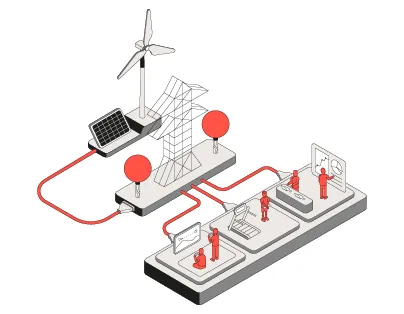
Energy distribution companies are the organizations that make the delivery of energy to the final consumer possible. In fact, within the Brazilian energy matrix, this consumption is driven by the transportation sector, with 32.7%, followed closely by industries, with 31.7%. And so on, until reaching households, which account for 9.9%
Speaking of energy consumption, if you are reading this text at night, there is probably a light on nearby, which is delivered precisely by these energy distribution companies. Furthermore, if you are reading this via a cell phone or laptop that is not plugged into an outlet right now, you left your device charging for some time, right?
We can list several assumptions like the ones made above. This is because, despite seeming invisible, electrical energy is present in our main daily activities. And it is the energy distribution companies that make all of this possible by delivering this energy directly to our homes, workplaces, and many other places.
So, so that you can get to know a little more about them, we will explain exactly what energy distribution companies are, how they operate, and what level of connection they have with the final consumer. Interested in learning more? Stay with us!
After all, what are energy distribution companies?
Energy distribution companies (public or private) are those responsible for the delivery and distribution of energy to the final consumer, regardless of their size. To do this, they use substations, conducting wires, transformers, and electrical grid measurement, control, and protection equipment.
Distribution companies even have the obligation to expand and modify their grids according to the needs of each area. This is done in accordance with the rights and obligations defined in concession contracts that are signed directly with the Federal Government. In short, these are documents that provide the legal basis for these distributors to operate in specific regions.
Up to this point, it is already clear that the operation of distributors plays an essential role in ensuring that final consumers are served with maximum quality and safety, right? But at the end of the day, how is this done?
Unlike other networked systems, such as water and gas, for example, electricity cannot be stored in an economically viable way. Consequently, the energy to be consumed must be produced and delivered immediately by the distribution companies.
Therefore, when there are imbalances between supply and demand (or even if there are other types of imbalances), even if for fractions of a minute, the system runs the risk of cascading shutdowns, thus causing the famous “blackouts”.
How do energy distribution companies operate?
In Brazil, electricity distribution companies operate in natural monopolies. Their revenues are regulated by the National Electric Energy Agency (Aneel), which creates virtual competition mechanisms, such as public auctions, aimed at guaranteeing the lowest prices. This happens because, according to the regulatory agency, “competition in this segment would not generate economic gains”.
It is worth noting that these distributors collect and then pass on taxes and charges among the business parties. In this case, the energy tariff for the consumer consists of:
the energy consumed itself;
transportation to consumer units (considering transmission and distribution);
taxes and levies (PIS, Cofins, and ICMS);
and sectoral charges.
An interesting fact is that in 2019, Aneel published Technical Note (TN) 27/2019, in which it analyzed the performance of electricity distributors over the last 20 years. The document states that the portion of the tariff related to the distribution service dropped 52% between 2001 and 2017, going from R$ 208 to R$ 99 per MWh.
This result stems from “substantial efficiency gains by distributors,” which increasingly seek to develop and reduce operating costs.
Now that we have explained what energy distribution companies are and how they operate in Brazil, we will clarify a common question related to the possibility of choosing the service provided by the distributor.
Can I choose another electricity distributor?
When it comes to energy distribution, it is important to understand that the transportation of electricity in the country is a monopoly per concession area. Therefore, there is no way to choose another distributor, since the transportation of this energy is always done by the one that serves your region.
The concession of the distribution service is based on the geographic service area and also on the consumers who will be served. In addition, the distribution grid must be continuously adapted to meet the evolution of demand, such as the growing expansion of cities and neighborhoods.
As we explained, it is not possible to choose another distributor. On the other hand, by migrating to the Free Energy Market, you can choose who to buy energy from and even opt for renewable sources, while keeping the transportation through the distributor that already serves you and, for this reason, maintaining the same energy quality you have today.
For content about energy explained in a simple way, follow other content from Serena Talks. Until next time!
See also:

Redação Serena Energia
We are part of Serena, one of the country's leading generators and traders of clean energy, with 15 years of experience connecting people and businesses to sustainable and competitive solutions. Here on the blog, you'll find content on the electricity sector, Free Energy Market, sustainability, and energy transition, with clear explanations to support decisions in your daily life, whether at home or in your business.
Editor
Leave a comment
Your email address will not be published. Required fields are marked with *