
What is sustainable energy and examples in Brazil
Written by: André Lima, Growth, Serena Energia
Main takeaways from this article
-
Sustainable energy is obtained from renewable sources with traceability proven by certificates such as I-REC, which allows declaring 100% clean consumption and reducing Scope 2 emissions.
-
Group A companies can migrate to the free electricity market, negotiate price, term and renewable source directly with generators or traders, and keep physical delivery through the local distributor.
-
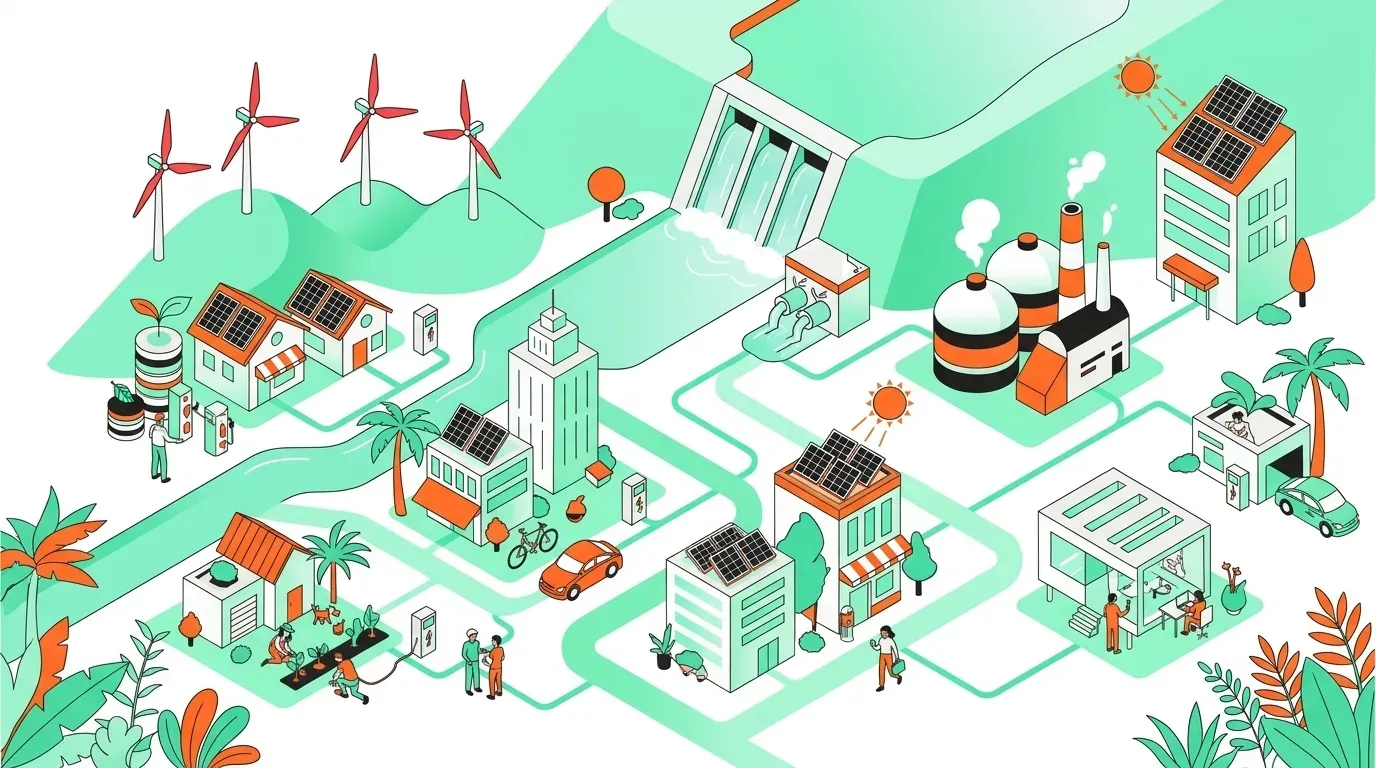
Brazil has one of the world’s electricity mixes with the highest renewable share, highlighted by hydroelectric, wind, solar and biomass distributed across all regions.
-
Migrating to the free electricity market takes about six months, eliminates the uncertainty of tariff flags and brings budget predictability with long‑term contracts.
-
Serena Energia conducts the migration process, issues I‑RECs to prove renewable origin and offers specialized support. Talk to one of our consultants to start your transition.
What is sustainable energy?
Sustainable energy is energy obtained from sources that naturally renew themselves and, when exploited responsibly, do not deplete resources available for future generations. This concept includes wind, photovoltaic solar, small‑ and large‑scale hydroelectric, biomass and biogas.
The central characteristic is regenerative capacity. The wind keeps blowing, the sun keeps shining and organic matter keeps being produced, regardless of the amount of energy generated.
In the Brazilian corporate context, sustainable energy means renewable energy with source traceability. It is not enough that the source is clean. A certification mechanism must exist, such as the I‑REC (International Renewable Energy Certificate), which proves, megawatt‑hour by megawatt‑hour, that the electricity consumed by the company was generated by a renewable source and injected into the grid.
Main renewable sources in Brazil in 2026
Brazil has one of the world’s electricity mixes with the highest renewable participation, the result of decades of investment in hydroelectricity and, more recently, rapid expansion of wind and solar sources. The sections below present the main sources that compose this mix.
Hydroelectric energy
Hydroelectricity is the historic backbone of Brazilian electricity generation. Large plants located in the basins of the Paraná, São Francisco and Tocantins rivers account for a significant share of the country’s installed capacity.
Wind energy
Brazil is among the largest wind markets in the world. Wind farms are mainly concentrated in the Northeast, in states such as Rio Grande do Norte, Ceará, Bahia and Piauí, as well as in Rio Grande do Sul, where wind regimes are consistent and above the global average. This results in high capacity factors and stable generation throughout the year.
Photovoltaic solar energy
Solar generation has grown dramatically in recent years, driven by falling panel costs and high solar irradiation across virtually the entire national territory. States such as Minas Gerais, São Paulo, Bahia and Mato Grosso host a relevant share of large‑scale projects.

Biomass and biogas
Biomass, especially sugar‑cane bagasse, is a relevant source in the Brazilian electricity mix, with plants mainly located in the sugar‑cane producing regions of the Central‑South. Biogas, derived from agro‑industrial and urban waste, represents a frontier of expansion with significant potential for the coming decades.
If your company generates organic waste or operates in the agro‑industrial chain, talk to our consultants to assess how biomass and biogas can integrate into your renewable energy strategy.
Concrete examples of wind, solar, hydroelectric and biomass energy in Brazil
Brazil’s geographic diversity allows each renewable source to be exploited in regions with the greatest natural potential. This combination distributes generation across the territory and reduces the risk of scarcity concentrated in a single source.

In the Northeast, large‑scale wind complexes operate in regions with constant winds throughout the year, guaranteeing predictable and efficient generation. In the South, wind farms take advantage of the wind regime in Rio Grande do Sul, a state with a tradition in generating this source.

In the Southeast and Central‑West, hydroelectric plants of various sizes use the large river basins, while biomass plants process waste from the sugar‑cane agro‑industry. In the North, large‑scale hydro projects operate on high‑flow rivers such as the Tocantins and the Xingu.

Serena Energia, one of the largest wind and solar generators created in the Americas, operates 17 plants in Brazil and the United States, with capacity to supply the equivalent of 4.2 million households. Since 2017, the company has avoided the emission of more than 2.14 million tonnes of CO₂.
Want to know which wind or solar park would supply your company’s energy? Our consultants can map the exact origin and the corresponding I‑REC certificates for your consumption.
How Brazilian companies are adopting renewable energy day‑to‑day
Brazilian companies adopt renewable energy mainly through the free electricity market. In this environment, Group A companies can choose their energy supplier, negotiate price, term and source, instead of following only the rates regulated by ANEEL.
Migrating to the free electricity market does not change the physical delivery of electricity. The local distributor remains responsible for cables, transformers and network quality. What changes is the commercial contract. The company starts buying electricity from a generator or trader of its choice, such as Serena Energia, and pays the distributor only for the transportation service.
Proving clean origin: I‑RECs and carbon credits
ESG managers need to prove the renewable origin of energy with the same attention given to procurement. The I‑REC (International Renewable Energy Certificate) is the most widely used global instrument for this purpose. Each certificate represents 1 MWh of energy generated by a renewable source and injected into the electric grid.
The I‑REC is traceable, auditable and recognized in sustainability reports aligned with international standards such as the GHG Protocol and Scope 2 reporting frameworks. By contracting renewable energy with I‑REC issuance, a company can formally declare its electricity consumption 100% clean and reduce its Scope 2 emissions to zero.
For organizations seeking to go further and neutralize emissions from other sources, carbon credits from certified projects complement the decarbonization strategy. Serena Energia issues I‑RECs corresponding to each client’s consumption and offers access to carbon credits for neutralizing additional emissions.
Typical steps to migrate to the free electricity market
1. Verify eligibility
The first step is to confirm that the company is in Group A, i.e., connected at medium or high voltage. There is no minimum consumption to participate in the free electricity market; you only need to belong to this tariff group.
2. Analyze consumption profile
Mapping monthly consumption in kWh and contracted demand guides the choice of contract type. This analysis allows projecting the expected savings from migration.
3. Choose a trader and close the contract
The company selects an energy supplier and signs a bilateral contract, usually long‑term, with a pre‑agreed price. This mechanism eliminates the uncertainty of tariff flags in the regulated market and brings cost predictability.
4. Register the company with CCEE (Chamber of Electric Energy Commercialization)
Registration with CCEE (Chamber of Electric Energy Commercialization) is mandatory to participate in the free electricity market. Since this process involves technical documentation and specific regulatory deadlines, Serena Energia handles all steps for the client, reducing the need to deal directly with bureaucracy.
5. Adapt the measurement system
Installing measurement equipment compatible with the free electricity market is necessary to record consumption accurately. Serena Energia is responsible for installing this equipment and integrates this step into the migration process for the client.
6. Start supply and monitor results
After the migration period, which takes six months from the notification to the distributor, the company begins operating in the free electricity market. A dedicated Serena Energia consultant will accompany
the monthly performance is available for questions and contractual adjustments.Operational and sustainability benefits for companies
The migration to the free energy market with renewable source contracting generates operational and sustainability benefits for Group A companies.
The first benefit is contractual predictability. With price agreed in advance for periods of three to five years, the company eliminates the uncertainty of tariff flags and can plan its energy budget more accurately.
The second benefit is the traceability of the energy source. Through I-RECs, the company auditable proves that its consumption is 100% renewable and meets the requirements of stakeholders, investors, and ESG reporting frameworks.
The third benefit is management simplification. In the retail model of the free energy market, Serena Energia represents the company before the CCEE, handles sectoral obligations and centralizes billing. The client receives an energy invoice and a distribution invoice, with support from a dedicated consultant.
Summary of key points
Sustainable energy is energy from renewable sources with proven source traceability. Brazil has one of the most renewable electric grids in the world, with hydroelectric, wind, solar, and biomass distributed throughout the territory.
Group A companies can contract certified renewable energy through the free energy market, keep physical delivery by the local distributor, and negotiate price and term with the supplier of their choice. The migration process takes about six months and can be conducted entirely by a specialized retailer.
I-RECs and carbon credits complete the sustainability strategy, allowing the company to prove and neutralize its Scope 2 emissions and advance decarbonization goals.
Frequently Asked Questions
Can any company migrate to the free energy market?
Yes, as long as the company is in Group A. There is no minimum consumption to participate in the free energy market. Serena Energia conducts the eligibility analysis at no cost to the interested party.
How long does the migration to the free energy market take?
The regulatory process takes six months, counted from the formal notification to the distributor. During this period, the retailer conducts the bureaucratic steps and prepares the company to start supply in the new contracting environment.
What is the I‑REC and how is it used in ESG reports?
The I‑REC (International Renewable Energy Certificate) is an international certificate that proves that 1 MWh of energy was generated by a renewable source and injected into the electric grid. This certificate is traceable from the generating plant to the final consumer and is recognized by the main global sustainability reporting frameworks, such as the GHG Protocol.
With I‑RECs, the company can formally declare that its electricity consumption is 100% renewable and record Scope 2 emissions equal to zero in annual reports.
What is the difference between the free energy market and the captive market?
In the captive market, the company purchases energy exclusively from the local distributor, at prices regulated by ANEEL, subject to annual adjustments and tariff flags. In the free energy market, the company chooses its supplier and negotiates price, term, and source directly.
As mentioned earlier, the distributor retains its responsibility for the physical infrastructure in both cases. The difference lies in the commercial relationship and cost predictability.
Does migration to the free energy market represent a risk to the operation?
No. Migration is a commercial and contractual process. The local distributor remains obligated to deliver electricity and maintain network quality, regardless of who supplies the energy. The company's operation does not experience interruption during or after the migration.
Conclusion
Sustainable energy has become a management decision with a direct impact on financial planning and ESG goals of Brazilian companies. With an electric grid rich in renewable sources and a free energy market open to all Group A companies, Brazil offers concrete conditions to contract clean, certified electricity with greater cost predictability.
Serena Energia, with more than 17 years of history and presence among the largest wind and solar generators created in the Americas, conducts the migration process, issues I‑RECs for renewable source verification, and offers a dedicated consultant for continuous monitoring.
Talk to one of our consultants and take the next step towards more predictable, clean, and strategic energy for your business.

André Lima
We are part of Serena, one of the country's leading generators and traders of clean energy, with 15 years of experience connecting people and businesses to sustainable and competitive solutions. Here on the blog, you'll find content on the electricity sector, Free Energy Market, sustainability, and energy transition, with clear explanations to support decisions in your daily life, whether at home or in your business.
Editor
Leave a comment
Your email address will not be published. Required fields are marked with *