
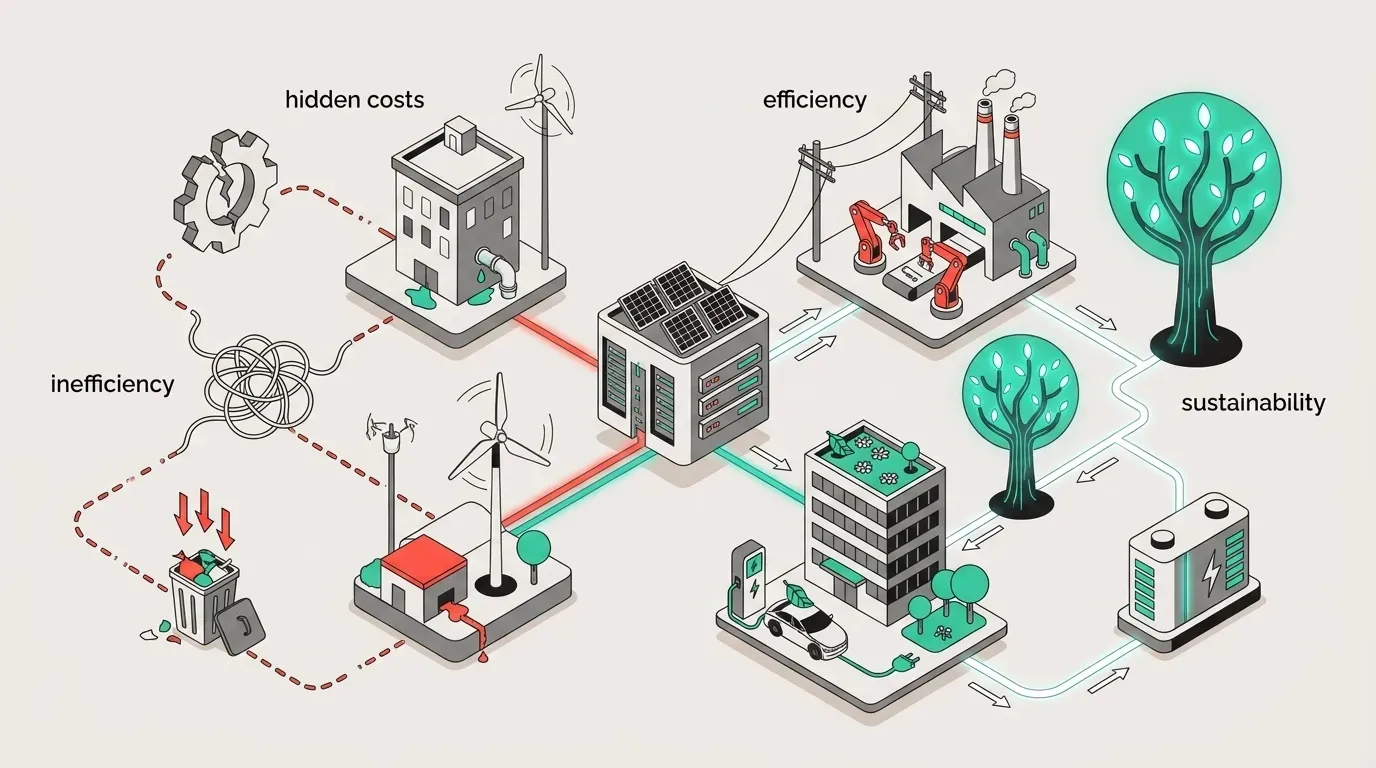
Examples of invisible expenses that increase the company's costs
Written by: André Lima, Growth, Serena Energia
Key lessons from this article
- Invisible costs, such as tariff fluctuations and rework, erode margins without appearing explicitly in the budget.
- Migrating to the free energy market eliminates the unpredictability of tariff flags and allows fixed‑price contracts.
- Contract review processes, consumption mapping and standardization reduce operational and energy waste.
- Group A companies can obtain certified renewable energy and cost predictability by migrating with a specialized generator.
- Talk to Serena Energia to identify and eliminate your invisible costs.
Example 1 – Energy contract volatility in the captive market (largest impact)
The captive market exposes the company to an energy cost that changes frequently. ANEEL sets the price and applies annual adjustments and tariff flags green, yellow, red 1 and red 2, which increase the electricity bill during periods of water scarcity. For a CFO, this dynamic creates a cost line that varies month to month and reduces the reliability of any OPEX projection.
This uncertainty affects planning and resource allocation. Finance teams need to set aside safety margins that could fund growth, and a single quarter with higher‑cost flags already jeopardizes goals set at the beginning of the year.
Migrating to the free energy market creates predictability. Long‑term bilateral contracts lock in the energy price in advance. Serena Energia, one of the largest wind and solar power generators founded in the Americas, offers managed migration at no additional cost and contracts that can generate savings compared to the regulated market.

Example 2 – Rework and operational errors
Rework represents the cost of performing a task twice that should have been completed correctly the first time. In industrial and commercial environments, this issue consumes labor hours, increases the use of inputs and raises energy consumption to reprocess batches or correct production failures.
The financial impact rarely appears in a single line item because rework affects multiple cost centers simultaneously. It spreads across overtime to fix failures, disposal of materials used incorrectly, and prolonged use of equipment that needs to reprocess batches, generating costs that go unnoticed in the monthly close because they are fragmented across different budget lines.
Mapping failures and standardizing procedures reduces the incidence of rework. When a company combines these adjustments with efficient energy management, such as that offered by Serena Energia with managed migration at no additional cost, it begins to control both the process cost and the energy cost that sustains it.
Example 3 – Idle capacity and equipment shutdowns
Keeping equipment running without effective production means paying for energy with no return. Unplanned shutdowns also generate demand spikes at the moment of restart, which can raise the contracted demand and increase the next bill in the captive market.
Idle capacity appears at various points in the infrastructure. Climate control systems remain active outside operating hours, lighting stays on without automation, and compressors run at partial load for long periods. Together, these factors create a silent resource leak that reduces overall operational efficiency.
Serena Energia offers energy consulting and energy management at no additional cost for clients under its management. This service enables identifying waste points and correcting them within a free energy market contract with predictable pricing.
Comparison: captive market vs. free energy market
The table below summarizes structural differences between the two models. The focus is on cost predictability and the possibility of contracting renewable energy, factors that directly influence the management of a company's invisible expenses.
| Criterion | Captive market | Free energy market |
|---|---|---|
| Cost predictability | Low: price subject to annual adjustments and monthly tariff flags set by ANEEL | High: price fixed in long‑term bilateral contract, without exposure to tariff flags |
| Supply risk | The local distributor is responsible for the physical delivery of energy | The local distributor remains responsible for physical delivery, and the commercial negotiation is done with the chosen generator |
| Renewable source certification | Not available as a direct contractual option | Available via I‑RECs issued by the generator, verifiable in sustainability reports |
Example 4 – Unproductive meetings and poorly planned overtime
Meetings without a clear agenda, without recorded decisions, and with excessive participants consume hours of high‑cost professionals. When this time accumulates over the month, the impact on the payroll becomes significant and rarely appears as a specific waste line in the management report.
Poorly planned overtime follows the same logic and amplifies the problem. It arises as a short‑term solution to bottlenecks that could be solved with better workload distribution. This additional personnel cost comes with energy consumption outside standard operating hours, since keeping the production structure active beyond the shift requires climate control, lighting and equipment running for a reduced team, which raises the cost per worked hour.
Time‑management tools and periodic process reviews reduce this waste. Serena Energia, with managed migration at no additional cost, frees the finance team from part of the operational routine of the electricity bill and allows the team to spend more time on strategic decisions.
Example 5 – Idle or expired inventory
Idle inventory ties up capital and generates continuous operational costs. Storage, climate control, lighting and security systems remain active regardless of whether the inventory is moving or not. Expired products also add disposal costs and potential replenishment.
Companies with warehouses or cold rooms feel this impact more intensely. Each square meter climate‑controlled without product movement represents energy consumed without revenue offset and reduces space‑use efficiency.
Reviewing purchasing policies and aligning demand and replenishment reduces this cost. In the energy field, contracting energy in the free energy market with Serena Energia helps keep the cost of maintaining the storage structure predictable and aligned with financial planning.
Example 6 – Forgotten service contracts and tools
Service contracts and digital tool licenses hired for specific projects often remain active after those projects end. Without periodic review of the supplier portfolio, these amounts accumulate month after month without delivering value to the operation.
The same pattern repeats in maintenance contracts, telecommunications services and management platforms that are no longer used. The lack of a formal contract review process keeps these invisible costs and makes it difficult to identify reduction opportunities.
Conducting semi‑annual audits of active contracts is a simple and effective practice. Serena Energia applies a similar logic to energy management, with continuous review of consumption and the contract and dedicated consulting at no additional cost for clients under its management.
Apply the same contract audit logic to your energy management — talk to our consultants.
Example 7 – High employee turnover
Replacing an employee involves more than the recruitment process. The cost includes onboarding time, learning curve, temporary drop in team productivity and, in industrial settings, the risk of operational errors during the adaptation period, which can generate rework, input waste and additional energy consumption.
Companies with high turnover constantly operate below potential efficiency. The cost per replaced employee is rarely accounted for in full, making it one of the most underestimated invisible expenses in performance analysis.
Retention policies, development plans and more efficient work environments reduce this cost. Serena Energia, with managed migration at no additional cost, helps ensure that resources freed by energy cost reductions are directed to people‑valuing initiatives.
Impact of the problem
The seven examples presented form a set of controllable leaks. Together, they compress margins, hinder budget planning and reduce the company's investment capacity. For Group A companies, the unpredictability of energy in the captive market, already detailed in the first example, amplifies the impact of all other invisible costs by compromising any attempt at reliable budget projection.
From a sustainability perspective, staying in the captive market also means forgoing the ability to certify the renewable origin of the consumed energy. This choice limits progress on ESG goals and reduces credibility with investors and commercial partners who monitor environmental indicators.
Alternatives to reduce invisible expenses
Reducing invisible costs requires visibility and a review routine. Process audits, supplier contract reviews and energy consumption mapping form a starting point applicable to companies of various sizes and sectors.
In the energy field, migrating to the free energy market is the most direct alternative for Group A companies seeking predictability and cost reduction. In this model, the company negotiates price, term and energy source directly with the generator, while the local distributor remains responsible for the physical delivery of electricity. Serena Energi
a offers this path with long‑term contracts, certified renewable energy and full process management.
Evaluation and Implementation
The migration process to the free energy market with Serena Energia follows defined steps. The first step is the eligibility analysis, which confirms whether the company is in Group A, with medium or high voltage supply. Next, Serena Energia analyzes the invoices and consumption profile to project savings and present a detailed study.
After the contract is signed, Serena Energia conducts the entire migration process, including registration with CCEE (Electric Energy Commercialization Chamber), measurement system adaptation, and notification to the distributor, at no additional cost to the client. The regulatory deadline is six months.
Talk to one of our consultants and start the eligibility analysis of your company for free.
After migration, Serena Energia represents the company before CCEE in the retail model, handles payment to the distributor, and provides a digital dashboard with monthly savings monitoring, a comparison between captive and free energy markets, and consumption forecasts. A dedicated consultant remains available for questions and performance monitoring.
Frequently Asked Questions
Does my company need a minimum consumption to migrate to the free energy market?
There is no minimum consumption. Any company connected at medium or high voltage, classified in Group A, can migrate to the free energy market, regardless of the monthly volume consumed. Serena Energia performs the eligibility analysis at no cost to the client.
How long does the migration process take?
The regulatory process takes six months, counted from the notification to the distributor. Serena Energia handles all bureaucratic steps, such as CCEE registration, measurement system adaptation, and contractual management, at no additional cost. Therefore, the sooner the company starts the process, the sooner it begins to save.
What happens if my company consumes more or less energy than contracted?
Free‑market contracts provide a consumption flexibility range. If the company operates outside this range, the difference is settled in the short‑term market. Serena Energia offers active management to minimize this exposure, monitoring consumption and advising adjustments when necessary.
How does renewable energy certification work in practice?
For each MWh consumed, Serena Energia can issue an I‑REC (International Renewable Energy Certificate), which tracks the energy from the generating source to the final consumer. This certificate is globally recognized and allows the company to auditable declare that its electricity consumption is 100% renewable, which is essential for sustainability reporting and ESG goal compliance.

Does the migration pose any risk to operational continuity?
The migration is a commercial and contractual process. The local distributor remains responsible for the physical delivery of energy and grid stability. Serena Energia is responsible for installing measurement equipment and for the entire adaptation process, with no impact on the client’s operation.
Conclusion
The seven examples presented, which include energy contract volatility in the captive market, rework, idle capacity, unproductive meetings, idle inventory, forgotten service contracts, and high turnover, share the fact that they are controllable when identified. Electricity, being one of the most significant and least predictable expenses for Group A companies in the captive market, deserves priority attention.
The most objective starting point is to share energy invoices with a specialist for a feasibility analysis. Serena Energia conducts this study at no cost and provides a clear savings projection before any contractual commitment.

André Lima
We are part of Serena, one of the country's leading generators and traders of clean energy, with 15 years of experience connecting people and businesses to sustainable and competitive solutions. Here on the blog, you'll find content on the electricity sector, Free Energy Market, sustainability, and energy transition, with clear explanations to support decisions in your daily life, whether at home or in your business.
Editor
Leave a comment
Your email address will not be published. Required fields are marked with *