
Carbon credit: what is it, how does it work?
Carbon credit is a tradable certificate that represents the reduction or removal of greenhouse gases (GHG), usually measured in tonnes of carbon dioxide equivalent (tCO₂e).
This mechanism emerged in the context of international climate agreements and has become a central tool in the carbon market, allowing organizations to offset residual emissions in a transparent and traceable way.
Continue reading to understand more about what a carbon credit is, how it works, its origin, and more.
What is a carbon credit?
As already mentioned, a carbon credit is a certificate, or a unit of measurement, used to quantify the reduction, removal, or capture of Greenhouse Gases in the atmosphere. Formally known as a Certified Emission Reduction (CER), the carbon credit acts as a digital asset that can be traded among companies, governments, and institutions looking to neutralize or offset their emissions.
How much is one carbon credit equivalent to?
In a standardized way in the global market, 1 carbon credit represents 1 tonne of carbon dioxide equivalent (tCO₂e). This metric allows different GHGs—such as methane (CH₄) and nitrous oxide (N₂O)—to be accounted for by converting them into CO₂ through equivalencies based on their global warming potential.
How are carbon credits generated?
Carbon credits are generated from projects that demonstrably reduce emissions or remove carbon from the atmosphere—such as actions linked to decarbonization, clean and renewable energy initiatives, as well as reforestation and biome restoration projects. In addition, carbon credits offer both climatic and strategic benefits for companies and governments:
Transparent accounting: they allow CO₂ reductions to be measured and reported in a verifiable and auditable way;
Sectoral flexibility: they can be used by different industries (energy, transportation, manufacturing, agribusiness);
Support for decarbonization goals: they facilitate compliance with climate commitments while the energy transition moves forward;
ESG value generation: companies aligned with corporate sustainability agendas strengthen their reputation and attract investors.
Investing in carbon credits, when done with high-integrity criteria, positions companies as protagonists in the low-carbon economy and adds value to the products and services offered. To support this communication consistently, a good step is to structure a sustainability report.
What is the origin of carbon credits?
Carbon credits were created in the context of international climate agreements to quantify and trade GHG emission reductions, laying the foundations of the modern carbon market.
Kyoto Protocol
The Kyoto Protocol, signed in 1997 and in force from 2005 onwards, was the first international agreement to establish mandatory emission reduction targets for developed countries. To facilitate compliance with these targets, the protocol created the Clean Development Mechanism (CDM), which allowed projects in developing countries to generate Certified Emission Reductions (CERs), the first official carbon credits.
Kyoto was fundamental because it established methodologies to measure, validate, and trade reductions, creating language and corporate governance for the market. However, the debate has evolved to reinforce that credits do not replace direct reduction and should only be used for residual emissions after genuine decarbonization efforts.
Paris Agreement and Article 6
The Paris Agreement (2015) replaced Kyoto and expanded climate ambition with reduction targets for all signatory countries. Within it, Article 6.4 created the Paris Agreement Crediting Mechanism, operated by the UNFCCC, which standardizes international methodologies and demands greater credit integrity (traceability, independent auditing, and clear rules).
For companies, this means access to credits with global recognition and a growing trend of requirements for quality and transparency in projects.
Carbon market: regulated vs. voluntary
The carbon market is the economic environment where credits are issued, bought, and sold by organizations that reduce emissions (suppliers) and by those that need to offset residual emissions (buyers). In practice, this market is divided into two major segments: regulated and voluntary.
If the goal is to understand how markets organize themselves and how contracting environments work, it is worth knowing the Free Energy Market.
Regulated Market (compliance)
In the Regulated Market, rules and emission limits are defined by governments, and specific companies or sectors must comply with legal obligations—being able to buy credits if they exceed their quotas. This model operates mainly through two mechanisms:
Cap-and-trade: governments set an emissions cap and distribute or auction allowances; companies that emit less can sell their surpluses;
Tax/pricing mechanism: governments set a fixed price per ton of CO₂ emitted, creating a financial incentive for reduction.
In Brazil, Law No. 15,042/2024 established the Brazilian Greenhouse Gas Emissions Trading System (SBCE), setting the foundations of the national regulated market with emission limits and asset trading.
Voluntary Market (offsets)
In the voluntary market, companies, NGOs, and governments buy credits on their own initiative, generally to fulfill internal ESG goals, climate neutrality commitments, or brand differentiation strategies.
This market requires extra attention to quality and transparent communication to avoid greenwashing—the use of credits cannot become a "shortcut" to continue emitting without genuine reduction efforts at the source. One way to reinforce coherence in this agenda is to understand the difference between sustainability and sustainable development.
Carbon credits and GHG
Greenhouse Gases (GHG) are compounds that trap heat in the atmosphere and contribute to global warming—including carbon dioxide (CO₂), methane (CH₄), nitrous oxide (N₂O), and fluorinated gases. The carbon credit emerged as a mechanism for quantifying and pricing these emissions, allowing them to be traded in organized markets.
The central point is that each credit generally represents 1 ton of CO₂ equivalent (tCO₂e) that was either not emitted or was removed from the atmosphere by validated projects. This standardization makes it possible to compare and sum reductions from different gases and sectors, enabling transparent transactions in the carbon market.
Trading carbon credits
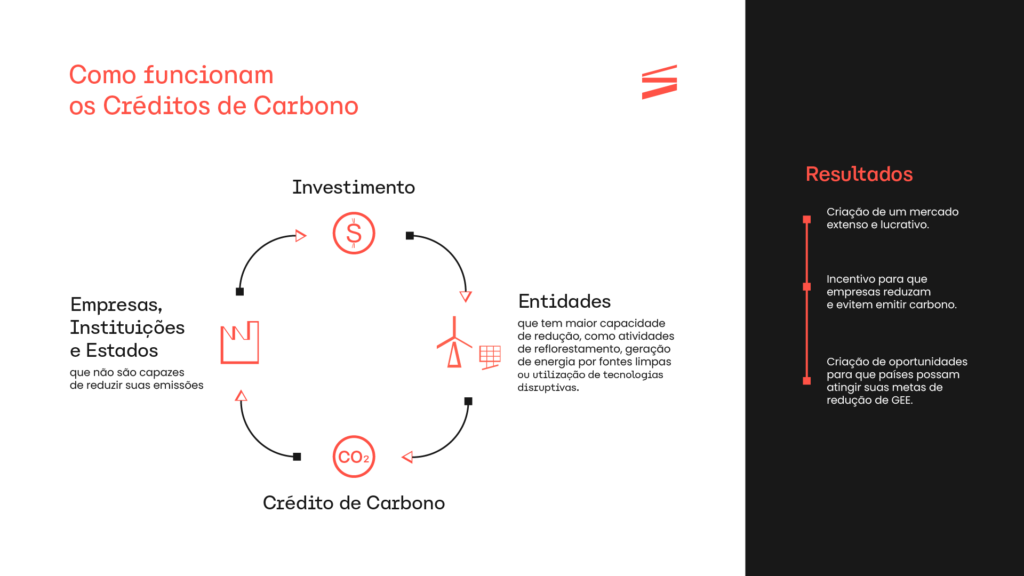
Governments, institutions, and companies that cannot completely reduce their GHG emissions buy carbon credits from organizations with a greater capacity for carbon reduction or capture. This trading takes place through:
Reforestation and restoration projects: which sequester CO₂ via vegetation growth;
Clean energy generation: which replaces fossil fuels and avoids emissions;
Efficiency and capture technologies: which reduce or remove GHGs from industrial processes.
Qualified companies, such as Serena, which avoids emitting tons of GHGs into the atmosphere through 100% clean energy generation, can register their assets for certification and the issuance of carbon credits, and trade them.
What are the challenges of the carbon market in Brazil?
Tons of GHGs continue to be emitted daily in Brazil and around the world, making the mobilization of companies, governments, and civil society urgent to curb global warming. The country, however, advanced significantly in 2024: the sanction of Law No. 15,042/2024 created the Brazilian Greenhouse Gas Emissions Trading System (SBCE), establishing for the first time specific national regulation for the regulated carbon market.
This regulatory milestone meets a long-standing demand from the sector and positions Brazil to take advantage of its enormous potential: according to McKinsey consultancy, the country can generate up to 15% of the global supply of voluntary credits based on nature-based solutions. In 2024, the state of Pará broke a record by selling 12 million carbon credits for about R$ 1 billion, demonstrating the economic viability of the market.
Despite the advances, the next challenge is the effective implementation of the SBCE, with clear methodologies and transparent monitoring mechanisms. Companies that get ahead by measuring emissions, investing in direct reduction, and offsetting with high-quality credits will be better positioned to compete in the low-carbon economy.
References
MCKINSEY & COMPANY. Mercado voluntário de carbono tem potencial gigantesco no Brasil. McKinsey & Company Brasil, 13 set. 2022. Available at: https://www.mckinsey.com.br/our-insights/all-insights/mercado-voluntario-de-carbono-tem-potencial-gigantesco-no-brasil. Accessed on: Jan. 9, 2026.
PARÁ. Secretaria de Estado de Meio Ambiente e Sustentabilidade. Pará assina acordo inédito e vende quase R$ 1 bilhão de créditos de carbono. Belém: SEMAS-PA, 24 set. 2024. Available at: https://www.semas.pa.gov.br/2024/09/24/para-assina-acordo-inedito-e-vende-quase-r-1-bilhao-de-creditos-de-carbono/ . Accessed on: Jan. 9, 2026.

Redação Serena Energia
We are part of Serena, one of the country's leading generators and traders of clean energy, with 15 years of experience connecting people and businesses to sustainable and competitive solutions. Here on the blog, you'll find content on the electricity sector, Free Energy Market, sustainability, and energy transition, with clear explanations to support decisions in your daily life, whether at home or in your business.
Editor
Leave a comment
Your email address will not be published. Required fields are marked with *