
How much does remote power generation cost for companies?
Written by: André Lima, Growth, Serena Energia
Key takeaways from this article
-
Group A companies face higher energy bills in 2026 and pressure for ESG results. The choice between remote energy generation and the free energy market becomes decisive to reduce costs and meet sustainability goals.
-
Remote energy generation allows entry without infrastructure investment, but the discount applies only to the consumption portion of the bill and does not offer standardized renewable certification.
-
The free energy market allows setting the price for a period of 3 to 5 years, with significant savings potential compared to the regulated market and issuance of auditable I-RECs for each MWh consumed.
-
Migration requires invoice analysis, consumption profile assessment, technical suitability verification, and alignment with ESG goals. Serena Energia conducts these steps at no additional cost to the client.
-
To obtain a personalized analysis and start migration with savings and renewable traceability, request a feasibility study with Serena Energia.
What is remote energy generation and how does it work?
Remote energy generation is a model in which a company purchases energy credits produced at a renewable‑source plant located outside its premises. These credits are offset on the local distributor’s invoice and reduce the amount charged for consumption. The model eliminates the need to install equipment on the company’s property and keeps the distributor responsible for the physical delivery of electricity.

The discount applies only to the consumption portion of the invoice, which usually represents between 60% and 75% of the total, and not to the full bill amount. A discount applied solely to the consumption portion generates an effective reduction on the total invoice after accounting for the monthly cost of the contracted plan. Moreover, discount percentages are estimates and vary according to the distributor, the plan, and the characteristics of each consumer unit. No supplier can define a fixed price per kWh without an individualized consumption analysis.
In the free energy market, the model is structurally different. The company contracts energy directly from a generator or trader, negotiating price, term, and volume. The local distributor remains responsible for the physical delivery of electricity, but the energy price is set in a bilateral contract, with long‑term predictability. Understanding these differences, the next step is to evaluate the practical criteria that guide the choice between the two models.

Comparison of alternatives: decision criteria
The choice between remote energy generation and the free energy market involves factors that go beyond the advertised discount. Initial investment, price predictability, management complexity, operational risks, and proof of renewable origin influence the decision of Group A companies.
The table below summarizes the main attributes of each model:
|
Model |
Initial investment |
Typical contract term |
Renewable certification |
|---|---|---|---|
|
Regulated market (status quo) |
None |
Indefinite, with tariff regulated by ANEEL |
Not available |
|
Remote energy generation |
None |
Variable, usually between 12 and 60 months |
Limited or non‑standardized |
|
Free energy market with Serena Energia |
Measurement adaptation costs assumed by Serena Energia |
Usually between 3 and 5 years, with fixed price |
I-REC per MWh consumed |
In the regulated market, companies are subject to periodic tariff adjustments and tariff flags that change the cost of energy according to reservoir conditions. Companies that remain in the captive market feel price increases indirectly, through subsequent tariff adjustments. In remote energy generation, the discount applies to a fraction of the invoice and does not eliminate exposure to distributor adjustments. In the free energy market, the price per kWh has been historically lower than the regulated tariff, with savings ranging from about 9% to over 40% depending on the period and region, and with the possibility of fixing the price for up to 5 years.
Regarding proof of renewable origin, remote energy generation does not offer, in a standardized way, globally recognized auditable certificates. The free energy market with Serena Energia includes the issuance of I‑RECs for each MWh consumed, a resource relevant for sustainability reporting and Scope 2 emissions target compliance.

Receive a personalized comparative analysis that considers your company's consumption profile.
Factors to evaluate before the decision
Making the decision between remote energy generation and the free energy market requires a structured analysis across four complementary dimensions.
The first dimension is invoice analysis. The consumption history of the last 12 months allows identifying seasonality, demand peaks, and the current bill composition, separating the energy portion from the distribution portion. This analysis creates the numerical basis for any savings projection.
With this base established, the second dimension is consumption profile. Companies with stable and predictable consumption tend to benefit more from long‑term contracts in the free energy market. The free energy market remains more advantageous for companies with a predictable consumption profile, structured energy management, and long‑term planning.
The third dimension is technical suitability. Migration to the free energy market requires the installation of a compatible measurement system, the SMF. Serena Energia assumes this process at no additional cost to the client.
The fourth dimension is alignment with ESG goals. Companies with public commitments to reduce Scope 2 emissions need auditable instruments. Procuring I‑RECs linked to energy consumption provides auditable proof of environmental progress and strengthens ESG reporting before stakeholders and audits.
Typical steps for contracting or migrating to the free energy market
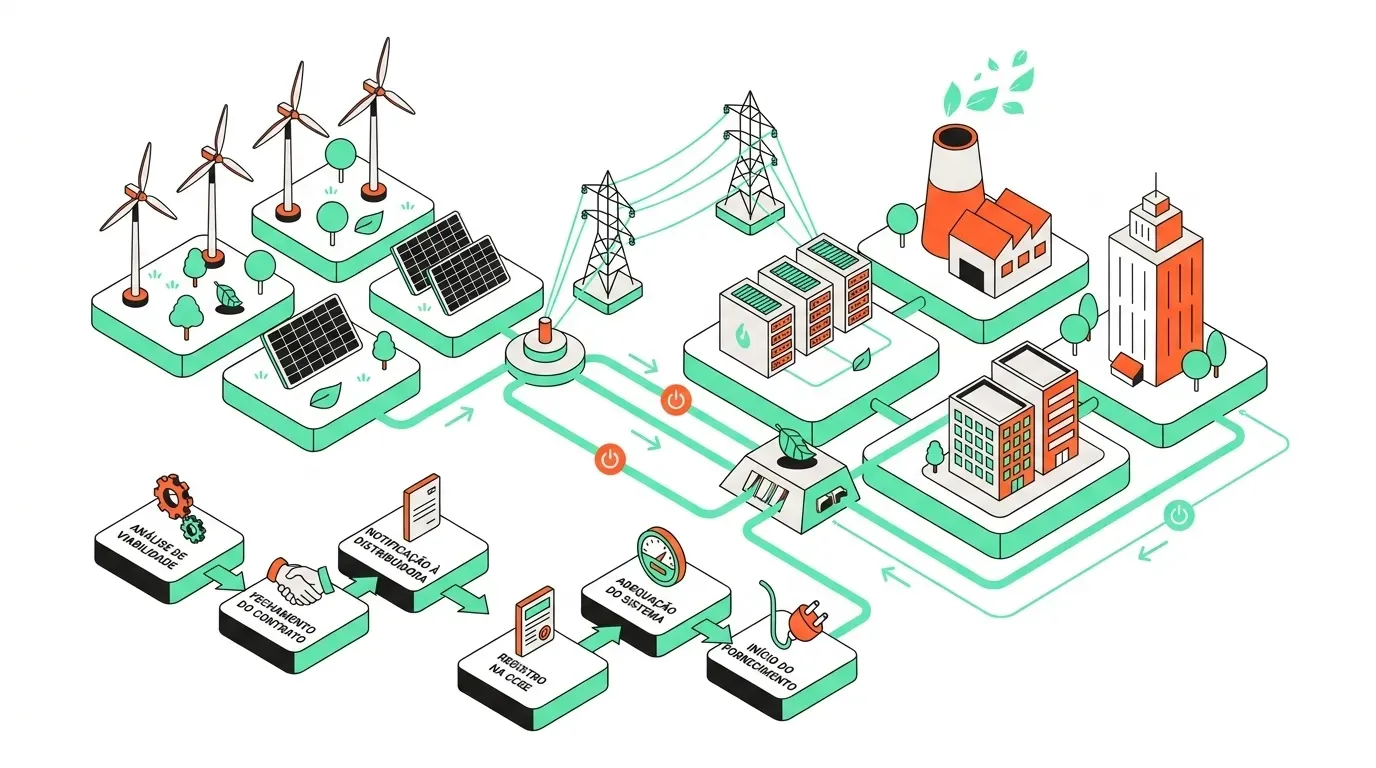
Migration to the free energy market follows a structured flow, with an average duration of six months from contract formalization. The steps below describe the typical path for Group A companies.
1. Feasibility analysis
Serena Energia analyzes the company's invoices and consumption profile to project the expected savings and present a detailed study, at no cost.
2. Contract signing
The company signs a contract with a term usually between 3 and 5 years and a fixed price per MWh. This arrangement reduces exposure to tariff adjustments during the term.
3. Notification to the distributor
The company formally notifies the local distributor about exiting the regulated market. This six‑month notice is a legal requirement and defines the start of the transition period.
4. Registration with CCEE (Electric Energy Commercialization Chamber)
The registration involves technical, legal, and financial documentation. Serena Energia conducts this process at no additional cost to the client.
5. Measurement system adaptation
Serena Energia installs measurement equipment compatible with the free energy market, at no charge to the client.
6. Supply start and monitoring
After migration, the company begins receiving energy from Serena Energia at the contracted price. A dedicated consultant monitors performance and supports continuous monitoring.
Serena Energia offers end‑to‑end managed migration and assumes regulatory bureaucracy for its clients.
Start the migration process with specialized support and reduce internal complexity.
Continuous operation and certificate issuance
After migration, energy management becomes continuous. Serena Energia represents the company before the CCEE (Electric Energy Commercialization Chamber) in the retail model, handling financial settlements, required resource contributions, and data transmission. The client receives two invoices, one for energy and one for distribution, and has a digital dashboard to track monthly savings, actual consumption, and future consumption forecasts.
For ESG goals, Serena Energia issues I‑RECs corresponding to each MWh consumed. These certificates trace the energy from the generating source to the final consumer and are globally recognized as auditable proof of renewable energy consumption. Since 2017, Serena Energia has prevented the emission of more than 2.14 million tonnes of CO₂, a direct result of the volume of clean energy supplied to its customers.

For companies that wish to go beyond Scope 2 emissions, Serena Energia also offers carbon credits from certified projects, complementing the decarbonization strategy.
Common Risks and Good Mitigation Practices
The migration to the free energy market involves specific risks, which can be mitigated with planning and choosing an experienced partner.
The first risk is exposure to the short‑term market. When actual consumption diverges from the contracted volume beyond the flexibility range stipulated in the contract, usually between 5% and 10%, the difference is settled in the short‑term market, where prices can rise during periods of water scarcity. Mitigation involves continuous consumption monitoring and proactive procurement adjustments.
The second risk is contracting a supplier without its own generation. Traders that rely solely on third‑party purchases are more exposed to price fluctuations and supply risk. Serena Energia operates as a generator with its own portfolio of operational plants, which brings greater solidity to the supply.
The third risk is late planning. Companies that sign long‑term contracts before peak demand periods tend to obtain more favorable terms and greater price predictability. Delaying the decision can mean contracting under less competitive conditions.
The fourth risk is the lack of traceability of the energy source. Without I‑RECs, the company cannot formally prove renewable energy consumption for ESG purposes and may face questions from auditors and stakeholders.
Summary and Practical Next Steps
Remote energy generation offers an entry alternative without infrastructure investment, but with a discount limited to the consumption portion of the bill, restricted price predictability, and non‑standardized renewable source traceability. The free energy market allows setting the energy price in the long term, with potential savings compared to the regulated market, centralized management, and I‑REC certification per MWh consumed.
For Group A companies, served at medium and high voltage, that seek operational cost reduction, budget predictability, and auditable ESG targets, the free energy market with Serena Energia is likely to be the most comprehensive alternative in 2026.
Practical next steps include gathering the energy bills from the last 12 months, mapping the monthly consumption profile, and starting a conversation with a specialist to receive a free feasibility study.
Request a personalized feasibility study and assess the potential for savings and renewable traceability for your company.
Frequently Asked Questions
What is the difference between remote energy generation and the free energy market for Group A companies?
In remote energy generation, the company purchases energy credits produced at a plant outside its premises. These credits are offset on the distributor’s invoice and reduce the amount charged for consumption. The discount applies only to the consumption portion of the bill, not the total. In the free energy market, the company contracts energy directly from a generator or trader, negotiating price, term, and volume. The local distributor remains responsible for the physical delivery of electricity, but the energy price is set in a bilateral contract for a period of 3 to 5 years, with predictability and without the distributor’s tariff adjustments applying to that portion during the term.
Can any Group A company migrate to the free energy market?
Yes. Group A comprises consumers served at medium and high voltage. Since January 2024, any company in this segment can migrate to the free energy market, regardless of consumption volume. There is no minimum consumption required. Serena Energia conducts the eligibility analysis at no cost to the interested party.
Does migration to the free energy market interrupt the energy supply?
No. Migration is a commercial and contractual process. The local distributor remains responsible for the physical delivery of electricity and network maintenance. The only change is the supplier from whom the company purchases energy. Serena Energia conducts the migration process, including measurement system adjustments, at no additional cost to the client and without impact on operations.
What are I‑RECs and why are they important for ESG reporting?
The I‑REC, International Renewable Energy Certificate, is a global certificate that audibly proves that 1 MWh of energy was generated from a renewable source and injected into the electric grid. When contracting energy with Serena Energia, the company receives I‑RECs corresponding to its consumption and can formally declare that its electricity is from a renewable source. This instrument is internationally recognized and is relevant for meeting Scope 2 emission reduction targets, sustainability reporting, and fulfilling investor and audit requirements. This volume of clean energy contributes to the previously mentioned environmental result, more than 2.14 million tonnes of CO₂ avoided since 2017.
How long does migration to the free energy market take and what are the costs for the company?
The migration process takes the previously mentioned timeframe, on average six months, determined by the prior notice required to terminate the contract with the distributor. Serena Energia handles the registration steps with CCEE (Electric Energy Commercialization Chamber), measurement system adjustments, and regulatory management, at no additional cost to clients under its management. After migration, the company receives a dedicated consultant for continuous monitoring of performance and energy costs.

André Lima
We are part of Serena, one of the country's leading generators and traders of clean energy, with 15 years of experience connecting people and businesses to sustainable and competitive solutions. Here on the blog, you'll find content on the electricity sector, Free Energy Market, sustainability, and energy transition, with clear explanations to support decisions in your daily life, whether at home or in your business.
Editor
Leave a comment
Your email address will not be published. Required fields are marked with *