
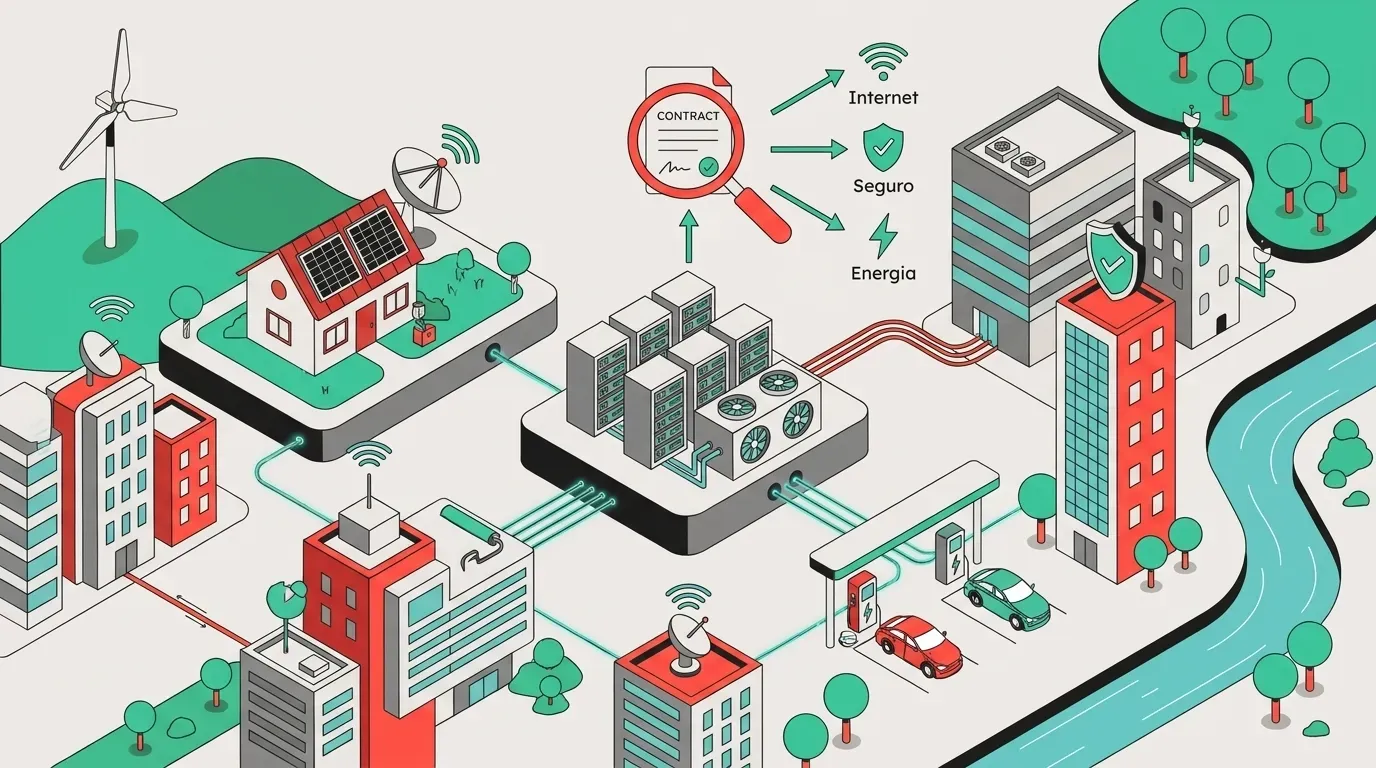
How to renegotiate internet, insurance, and energy contracts
Written by: André Lima, Growth, Serena Energia
Key lessons from this article
- Internet, insurance and energy contracts renew automatically, accumulate adjustments that are rarely reviewed and open space for quick savings.
- Mapping all contracts, analyzing actual consumption and obtaining competing proposals strengthens negotiating power.
- Migrating to the free energy market requires planning six months in advance and serves only Group A companies with medium or high voltage.
- Serena Energia conducts the entire migration process, with feasibility analysis, registration with CCEE (Electric Energy Commercialization Chamber), meter installation and monthly management, at no additional cost to the client.
- Companies that want to reduce costs and gain budget predictability in 2026 should start the process with Serena Energia now.
Prerequisites and initial conditions
Gathering documents and aligning internal departments speeds up any renegotiation.
Required documents:
- Last three internet invoices, including corporate broadband and dedicated links.
- Current insurance policies with detailed coverage and claims history.
- Last six electricity bills, with contracted demand and consumption in kWh.
- Active contracts with expiration dates and adjustment clauses.
Internal areas to involve:
- Finance and controlling: impact analysis on P&L and approval of new contracts.
- Facilities and operations: technical validation of connectivity requirements, insurance coverage and energy consumption profile.
- ESG and sustainability: assessment of decarbonization goals and eligibility for renewable certificates.
- Legal: review of termination clauses, fines and notice periods.
Energy eligibility condition: migration to the free energy market serves only Group A companies, with supply at medium or high voltage. There is no minimum consumption requirement; you just need to belong to this tariff group.

Process overview
The full renegotiation process for recurring contracts follows seven macro‑steps.
- Contract mapping: inventory all active contracts, values, expiration dates and adjustment conditions.
- Consumption and coverage analysis: verify whether what is contracted matches what the company actually uses.
- Market research: obtain alternative proposals to create negotiating power.
- Internet renegotiation: contact the current provider with a concrete proposal based on competition.
- Insurance renegotiation: review coverages and quote with other insurers.
- Migration to the free energy market: analyze feasibility, contract and execute the process with Serena Energia's support.
- Post‑negotiation monitoring: monitor invoices and cost indicators monthly.
The mapping, analysis, research and internet and insurance renegotiation steps can be completed in a few weeks. The free energy market migration step requires advance planning, as the process takes six months. The sooner the company starts, the sooner it begins saving.
Talk to one of our consultants to start your company's feasibility analysis at no cost.
The following sections detail each of these seven steps, with practical actions, internal owners and attention points.
Step‑by‑step guide
Step 1 — Map and audit all recurring contracts
Goal: have complete visibility of what the company pays, for how long and under what conditions.
Actions: consolidate all contracts into a spreadsheet, with supplier, monthly amount, expiration date, adjustment index and termination clause. This view allows identifying contracts with upcoming automatic renewal, which offer greater negotiation space, as the supplier tends to seek client retention.
Internal owner: controlling with facilities support.
Attention: contracts with loyalty clauses may incur early termination penalties. Calculate the exit cost before negotiating.
Step 2 — Renegotiate internet contracts
Goal: reduce the monthly connectivity cost or raise the service level without a price increase.
Actions:
- Request at least two proposals from alternative providers with equivalent specifications, such as speed, SLA and redundancy.
- Present the proposals to the current provider before the contract expires, preferably 60 to 90 days in advance.
- Negotiate price reduction, speed increase or inclusion of a stricter SLA as a counterpart for renewal.
Email script for internet renegotiation:
Subject: connectivity contract review — [Company name]
Dear [Commercial contact name],
Our corporate internet contract expires on [date]. We conducted a market survey and received proposals with competitive terms for the same service level. Before making a decision, we would like to evaluate a revised proposal from [current provider name] that reflects current market conditions. Can we schedule a meeting by [date]?
Risks: the provider may not have margin for reduction. In that case, migrating to a competitor may be a viable alternative. Assess the cost and timeline for link portability.
Step 3 — Renegotiate insurance policies
Goal: align coverages with the actual operational risk and eliminate overlaps or rarely used coverages.
Actions:
- Review the claims history of the past three years. Coverages never claimed can be reduced or eliminated.
- Request quotes from at least three insurers with the same coverage scope to create a comparative base.
- Negotiate higher deductibles in exchange for lower premiums, when the company's risk profile allows.
- Consolidate fragmented policies with a single broker to obtain volume discounts.
Internal owner: finance with facilities and legal support.
Attention: do not reduce contract‑mandatory coverages, such as insurance required by lenders or landlords. Validate with legal before any change.
Talk to one of our consultants and understand how migration to the free energy market complements the savings achieved in internet and insurance.
Step 4 — Analyze the feasibility of migration to the free energy market
Goal: confirm eligibility, project savings and start the process with sufficient lead time.
Actions: share the latest electricity bills with Serena Energia for analysis of consumption profile and contracted demand. Serena conducts this feasibility study at no cost to the company.
Condition: the company must belong to Group A, with supply at medium or high voltage. There is no minimum consumption requirement.
Attention: considering the migration timeline mentioned earlier, starting the process as soon as possible avoids missing another savings cycle.
Step 5 — Contract and migrate with Serena Energia (managed migration)
Goal: transfer energy supply to the free energy market without operational impact and at no additional migration cost.
Serena Energia is among the largest wind and solar power generators in the Americas, with over 17 years of history. In the free energy market, it operates primarily with wind energy. The process managed by Serena includes:

- Feasibility analysis: study of consumption profile and savings projection.
- Registration with CCEE (Electric Energy Commercialization Chamber): handling all required technical, legal and financial documentation, at no additional cost to the client.
- Metering system installation: adaptation of metering equipment, at no additional cost.
- Monthly management: representation of the company before CCEE, financial settlements and payment to the distributor, centralizing complexity and delivering a simple routine for the client.
The local distributor remains responsible for the physical delivery of energy, and wires, poles and network quality remain under the same management. The only difference is who sells the energy to the company.
Contracts in the free energy market have a pre‑agreed price, which eliminates the uncertainty of tariff flags and enables long‑term budget planning. Serena offers typically five‑year contracts, with 100% renewable energy and the possibility of issuing I‑RECs for sustainability reporting.

| Criterion | Captive market (distributor) | Free energy market (Serena Energia) |
|---|---|---|
| Supplier choice | No, single mandatory supplier | Yes, company chooses the generator |
| Price formation | Rate regulated by ANEEL with tariff flags | |
| Energy source | Untraceable grid mix | 100% renewable with I-REC certification |
| Bureaucratic management | Single distributor invoice | Serena manages CCEE (Electric Energy Commercialization Chamber) and the distributor, and the client receives a simplified invoice |
Step 6 — Close contract and monitor the transition period
Objective: formalize the contract with Serena Energia and monitor the migration steps without diverting the internal team from its duties.
Actions: after the contract is formalized, Serena fully takes over the process. The internal team stays in contact with the consultant assigned by Serena to track process milestones and validate the installation of the measurement system.
Step 7 — Monitor results and consolidate savings
Objective: verify whether the projected savings materialize and identify new opportunities.
Actions: compare monthly invoices with the period prior to migration, monitor the cost per kWh, and use the Serena Energia dashboard. This dashboard displays monthly savings, consolidated savings, a comparison between the captive market and the free energy market, consumption forecast, and actual consumption.
Common mistakes and troubleshooting
Frequent mistakes:
- Starting energy renegotiation too late: the six‑month deadline for migration to the free energy market does not shrink. Companies that wait for the current contract to expire before starting the process lose at least one semester of savings.
- Not mapping termination clauses before negotiating: internet and insurance contracts with early‑termination penalties can make switching providers more expensive than staying in the current contract.
- Comparing energy proposals without standardizing scope: comparing energy prices without considering management, measurement adequacy, and regulatory support leads to decisions based on apparent cost rather than total cost.
- Not involving legal in policy review: reducing insurance coverage without checking contractual obligations with third parties can generate contractual default.
- Underestimating internal alignment: migration decisions to the free energy market that do not go through finance, operations, and ESG tend to get stuck in approval or cause rework.
How to fix:
- Adopt a checklist per stage, with mapping, market research, negotiation, contracting, and monitoring.
- Define a single owner for each renegotiated contract and set a deadline for each stage.
- For energy, start the feasibility analysis process with Serena Energia even before defining the next fiscal year's budget, as the study is free and non‑binding.
Results verification and metrics
Comparing invoices after renegotiation quickly shows the impact of the actions.
After renegotiating internet and insurance, compare the invoices of the following three months with the equivalent period of the previous year, discounting expected contractual adjustments. The main indicator is the absolute monthly cost per service.
For energy, the key indicators are:
- Cost per kWh: compare the amount paid in the free energy market with what would be paid in the captive market during the same period, considering the current tariff flags.
- Budget predictability: verify whether the month's energy cost is within the plan. In the free energy market with a fixed price, significant deviations indicate consumption variation, not tariff changes.
- Consolidated savings: use the Serena Energia dashboard, which shows the total saved since the contract start and allows continuous monitoring.
Monthly monitoring also guides operational efficiency decisions. Consumption peaks identified in hourly measurements can indicate opportunities to adjust production processes.
Advanced options and next steps
Multiple consumer units: companies with more than one CNPJ or consumer unit can structure consolidated energy contracts in the free energy market, which improves the use of the total contracted volume. Serena Energia conducts feasibility analysis for each eligible unit.
ESG goals and certification: for companies with public decarbonization commitments, Serena Energia issues I-RECs (International Renewable Energy Certificates) for each MWh consumed. These certificates auditable prove that the consumed energy is of renewable origin and serve as a relevant instrument for sustainability reporting and Scope 2 target compliance. Serena also offers carbon credits to offset other emission sources.


André Lima
We are part of Serena, one of the country's leading generators and traders of clean energy, with 15 years of experience connecting people and businesses to sustainable and competitive solutions. Here on the blog, you'll find content on the electricity sector, Free Energy Market, sustainability, and energy transition, with clear explanations to support decisions in your daily life, whether at home or in your business.
Editor
Leave a comment
Your email address will not be published. Required fields are marked with *