
Complete guide to the Energy Free Market in a simple way
Talking about energy is still not as simple as turning on the light. Among so many technical terms, charts and typical sector procedures, there is the input that illuminates, gives life to ideas and moves everything from small to large gears.
If energy is movement, the best relationship we can have with it is dynamic and full of choices. This is the Free Energy Market: an environment that allows you to actively participate in the negotiation of your energy and combine, with one or more suppliers, contracts in the best terms for your company.
If you are not yet familiar with this term, we have prepared a comprehensive content here to simplify any and all doubts about the Free Energy Market.
In this article, you will learn:
1 – What is the Free Energy Market
2 – Physical world x commercial world
3 – Energy consumption in the Free Energy Market
4 – Types of energy in the Free Energy Market
5 – How the purchase of energy works in the Free Energy Market
6 – How the energy contract works in the Free Energy Market
7 – How to join the Free Energy Market
8 – Why adopt the Free Energy Market
9 – Overview of the Free Energy Market in Brazil and abroad
1 – What is the Free Energy Market
The Free Energy Market is a model of electricity commercialization that allows you to choose your energy supplier, shared desire by 8 out of 10 Brazilians.
This percentage was determined in 2020, in an opinion poll conducted by Ibope and the Brazilian Association of Energy Traders (Abraceel). It increases significantly every year, when this survey is usually updated.
The possibility of choosing from whom to buy the energy you use is already a reality for some companies. They are participants in the Free Energy Market, which in Brazil completed 25 years of existence in 2023. It was precisely in August 1998 that the National Electric Energy Agency (ANEEL) published resolution 265, allowing free negotiation of electricity in the country.
How does the Free Energy Market work?
In the Free Energy Market, there is competition among suppliers and more chances to find better energy prices. To give an idea, consumers in this market have already managed to save about R$ 200 billion, according to 2019 data from Abraceel.
The Free Energy Market is still an option available mainly only for companies, according to the amount of energy they contract.
With the change defined by Ordinance Normative MME No. 50, of September 27 2022, consumers of Group A (medium and high voltage) can now choose from whom to acquire their electricity.
Thus, businesses such as bakeries, shopping centers and restaurants connected to medium and high voltage can choose who will be the contracted energy generator. In this way, it is possible to negotiate prices, have greater spending predictability and be free from tariff flags.
Other particularities of the Free Energy Market will be presented below. But first, let’s understand a little more about energy, how it reaches you and how it is traded.
2 – Energy market: physical world x commercial world
All generated energy travels a path to your home or workplace: this is the “physical world”. In parallel, that same energy is traded in purchase‑sale contracts in the “commercial world”.
Who takes care of all the stages in the physical world is the National Electric System Operator (ONS). In the commercial world, this role belongs to the Electric Energy Commercialization Chamber (CCEE).
Physical world
The physical world is the route that energy follows. This route is mapped and forms the National Interconnected System (SIN), a transmission grid that covers almost the entire country. Each of these regions is considered a subsystem.
The interconnection of the subsystems helps us exploit the natural potential of each region, according to the time of year. An example is the rainy season, when it is possible to transfer energy to regions that are receiving less rain, serving everyone.
We have four subsystems in Brazil:
South;
Southeast/Central‑West;
Northeast;
North.
It is worth remembering that the naming of these subsystems does not follow the geographic division. The state of Acre, for example, is located in the North region, but belongs to the Southeast/Central‑West subsystem because of the ease of interconnection with Mato Grosso.
Not the whole country is covered by the SIN. There are 235 isolated locations, i.e., served by Isolated Systems. These locations are mainly in the North region, in the states of Acre, Amapá, Amazonas, Pará and Roraima.
There are also places in the Northeast, such as the island of Fernando de Noronha; in Pernambuco and in the Central‑West, in part of the state of Mato Grosso. In the physical world, energy is produced in generation parks. Then, it finds its way with the help of transmission and distribution companies, which transport and deliver the energy to everyone.
Commercial world
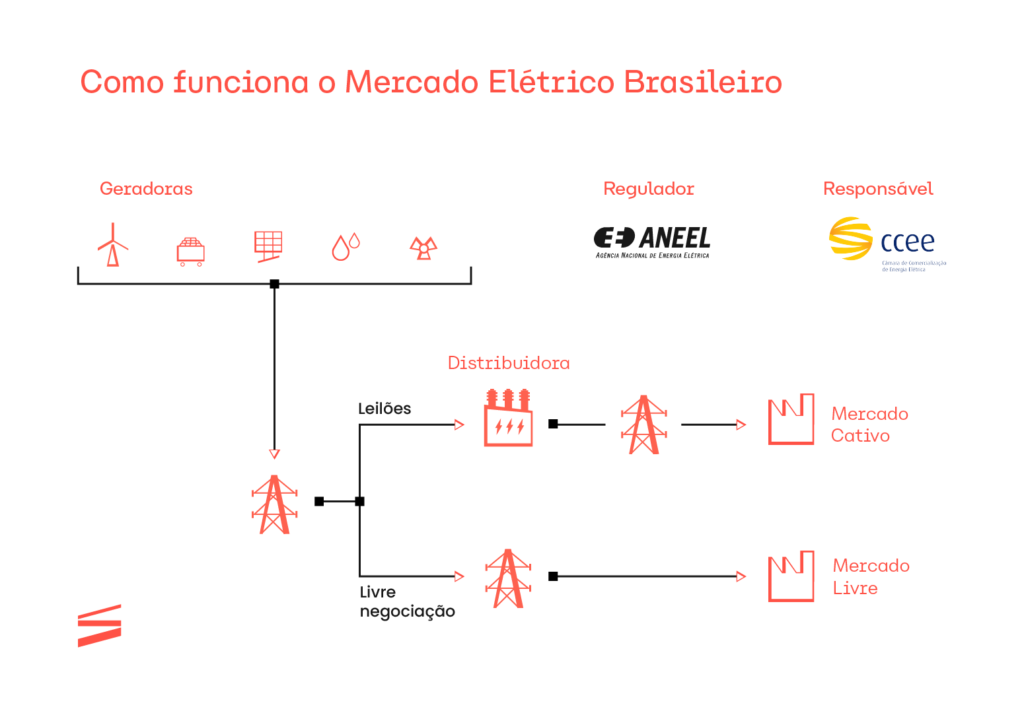
In the commercial world, all members of the SIN can trade energy among themselves, even if they are far apart. This includes distributors, generators, traders and free or special consumers.
It is divided into two environments: the Regulated Contracting Environment (ACR) and the Free Contracting Environment (ACL). In the first, we have captive consumers and in the second, free consumers.
Regulated Contracting Environment (ACR)
In the regulated environment, energy procurement occurs through auctions, regulated and carried out by ANEEL with the support of CCEE. They are the most common way to contract energy and are important for competition.
After the auctions, contracts between generators and distributors or energy traders are executed and recorded in CCEE, receiving the name Electric Energy Commercialization Contract in the Regulated Environment (CCEAR).
This type of contract has clauses and conditions regulated by ANEEL, therefore it cannot be freely altered by the parties.
Captive consumers pay a monthly invoice to the local concessionaire, also called the distributor. This invoice is composed of energy tariffs (consumption), transmission and distribution tariffs, and sectoral charges and taxes.
In addition, there are the tariff flags, released month by month, according to hydrological conditions for generation.
The green flag does not generate surcharges. However, the yellow flag and the red flag level 1 and 2, established when thermoelectric plants are activated, increase energy costs for the consumer.
Free Contracting Environment (ACL)
In the free environment, generators, traders, importers, exporters and free energy consumers negotiate price and other contractual conditions as they prefer.
The free consumers pay at least two invoices monthly. One of them is for the transmission or distribution company, which is responsible for physically delivering the energy. The other is paid to the chosen energy suppliers, i.e., generators and traders.
Here the number of invoices is relative to the number of contracts, that is, when negotiating with different agents, different invoices are paid for each.
The amounts paid are those previously defined in the contract and there are no tariff flags. These two environments share the same physical world, i.e., they receive the energy physically in the same way.
3 – Energy consumption in the Free Energy Market (measurements)
The measurement system of the captive market is well known. From it, monthly energy consumption is calculated by CCEE with the help of energy meters, the so‑called “clocks”.
The reading is performed over periods that vary from 28 to 32 days and the month’s consumption is calculated by the difference between the current reading and the last reading. These values are expressed in kWh or MWh, depending on the scale.
In the Free Energy Market, the distributor remains responsible for approving the adequacy of the measurement (whether the works are carried out by itself or by third parties).
Even in the migration phase, it assesses during a technical visit whether changes need to be made to adapt the Billing Measurement System (SMF).
The SMF consists of a physical structure that connects energy generation companies and free consumers to CCEE. This connection happens through a virtual system, the Energy Data Collection System (SCDE), where CCEE can determine the generated and consumed energy based on daily measurements.
In occasional cases where direct data transmission from the meter to CCEE is not possible, the distributor will perform the local reading and provide the data to the Chamber.
Thus, Free Energy Market customers can access their energy consumption at any time during the month, monitoring the mea
s partials.4 – Types of Energy in Brazil
Brazil is rich in water resources, so most of our installed capacity is composed of hydroelectric plants, about 55%. This contributes to our electric matrix being considered one of the most renewable in the world.
Currently, 84% of the matrix is formed by renewable energies. This includes other clean energy sources such as biomass, wind energy and solar energy, according to the National Electric Energy Agency (ANEEL).
The part of our matrix that corresponds to non‑renewable energy sources includes: natural gas, coal, oil and derivatives, and nuclear energy.
What types of energy are available in the Free Energy Market?
If you intend to buy energy soon but still don’t know where to start, here’s a tip: get to know the available options and understand the differences between them. In the Free Energy Market, you will find conventional energy and incentivized energy.
Conventional energy is generated in large hydroelectric plants or in thermoelectric plants (natural gas, coal, oil and derivatives). In this case, the energy is considered non‑renewable.
Incentivized energy, on the other hand, comes from sources such as small‑scale hydroelectric plants (or PCHs), solar energy, wind energy, biomass, or qualified cogeneration energy.
This type of energy receives its name because it carries discount percentages, encouraging consumers to invest in this renewable energy. Thus, the energy matrix is diversified with sources that have lower environmental impact.
These discounts are applied to the Transmission System Use Tariff (TUST) or to the portion related to energy transport within Distribution (“TUSD‑Transport”, also called “TUSD‑Demand” or “Wire” in industry jargon).
What is TUST?
The Transmission System Use Tariff (TUST) corresponds to a fee charged by the system operator (ONS) on behalf of the transmission companies.
It is related to the costs of transporting energy from generators to distributors and large‑scale free consumers directly connected to the so‑called Basic Grid (voltage ≥ 230 kV).
Although not part of TUST, sectoral charges (such as CDE and PROINFA) are also paid by these free consumers directly connected to the transmission network.
What is TUSD?
The Distribution System Use Tariff (TUSD) corresponds to a fee charged by the distributor and is divided into three sub‑components:
TUSD‑Transport (TUSD‑Demand or “Wire”): related to the costs of transporting energy and the distributor’s remuneration for the service provided,
TUSD‑Charges: related to the funding of public sector policies,
TUSD‑Losses: linked to energy losses in its distribution.
TUSD‑Demand is calculated in R$/kW (or volumetrically, in R$/MWh, in a specific case when consumption occurs during peak hours of the Green Tariff). It considers only the demand contracted by the consumer.
Meanwhile, TUSD‑Charges and TUSD‑Losses have their costs multiplied by the monthly consumption of that unit, in R$/kWh or R$/MWh. In other words, the higher the consumption, the higher the tariff.
How to Choose the Type of Energy in the Free Energy Market?
A client who contacts a supplier in the Free Energy Market may encounter:
Conventional energy (formally “non‑special conventional”), without discount on TUST or TUSD‑Transport, and which does not serve to back the consumption of special consumers;
Special conventional energy, without discount on TUST/TUSD‑Transport (“I0” in industry jargon), but which serves to back the consumption of special consumers;
Special incentivized energy, with discounts of 50%, 80% or 100% on TUST/TUSD‑Transport (known in the sector as “I5”, “I8” and “I1”, respectively) and which serve to back the consumption of special consumers;
Non‑special incentivized energy, with discount on TUST/TUSD‑Transport (“CQ5” in industry jargon), but which does not serve to back the consumption of special consumers.
Before Ordinance MME No. 50/2022, there was a differentiation between “free” and “special” consumers. Free consumers could use energy of any type, while special consumers could only acquire energy from special‑type sources (the I0, I5, I8 and I1 mentioned earlier).
This differentiation was based on a minimum load of 3,000 kW, which was gradually reduced to 500 kW. By allowing migration to the free market for any consumer connected to high voltage starting January 1 2024, the Ordinance eliminated this distinction.
Which type of energy is the most economical?
The price of each type of energy can vary several times in the same day. But, besides considering this value, we need to analyze other factors to make the most economical choice.
Some examples are:
Contracted demand;
Energy consumption volume;
Tariff modality (blue or green);
Voltage level;
Local distributor.
Incentivized energy, by itself, has higher added value since it is renewable. When there is still a discount on TUSD, its final cost can be more attractive compared to conventional energy.
The discount is always applied to the portion related to “demand” or “wire” of your tariff modality. If it is a “Blue Tariff”, the reduction will be applied to TUSD peak‑demand and off‑peak‑demand in R$/kW.
For the “Green Tariff” modality, the discount applies to TUSD off‑peak‑demand in R$/kW, but also to TUSD peak‑demand, which is charged in R$/MWh.
This is an important point of attention, because the “demand” portion during peak hours is charged in a volumetric and increased manner under the Green Tariff modality.
This is a way to encourage consumers who choose this modality to reduce or even avoid consuming grid energy during peak hours.
It is worth remembering that to be entitled to the full discount, the amount of contracted energy must equal the amount consumed. For example, if consumption exceeds the contracted energy volume, a weighted average is performed to apply the discount proportionally, and the un‑contracted volume does not receive a discount.
Therefore, to answer which type of energy is the most economical, it is necessary to know the consumption profile exactly, according to the factors listed above, in order to request and compare proposals from trusted marketers.
5 – How Energy Purchasing Works in the Free Energy Market
Energy purchasing is done through short‑ or long‑term contracts. These contracts are signed between consumers and energy marketers, who may use specialized consultancies if they wish.
They are bilateral, i.e., they have conditions negotiated between the parties.
For a good negotiation it is recommended to have an energy procurement strategy. It will help you understand your needs and thus choose the ideal product, thinking not only about price but also about contractual flexibilities.
To outline this strategy, we recommend the following flow:
Consumption curve analysis
Observe the energy consumption history of the last 12 months (at least) and see if there are significant month‑to‑month variations.
These variations, plotted on a graph, form a curve, facilitating consumption forecasting for the next energy procurement. Reflect on whether there is an expectation of increase or reduction in future consumption (new projects, equipment acquisitions).
Demand utilization analysis
Check your demand over the last 12 months, highlight the maximum demand and note how close this number is to your contracted demand.
If the maximum demand is much lower than the contracted one, there is over‑contracting. Conversely, if it is much higher, there is under‑contracting.
To find the ideal demand, we suggest adding 10% to the maximum demand read. There is no formal rule about this, but adding this percentage is advisable as a safety margin in case demand is exceeded.
This simple adjustment can provide savings on the energy bill every month.
Choosing the best energy source
After completing the two previous steps and knowing the volume of energy to contract and the ideal demand, this is the moment to analyze the sources available in the market.
The source choice results from a careful analysis of the factors: demand and consumption, tariff modality (green or blue), voltage level, and the final discount value on TUSD demand and/or TUSD charge provided by the distributor.
Selecting the generator/marketer and requesting a proposal
Once the source is chosen, you request a quote from trusted energy marketers that have the selected energy, indicating the other product characteristics you wish to acquire.
Some examples are:
Term;
Volume;
Service level percentage;
Number of consumer units;
Seasonality;
Flexibility;
Sub‑market, among others.
These items will be explained in more detail in the next section.
By choosing Serena Energia, the client opts for 100% clean energy directly from the source. In addition, savings can reach up to 30% and the company understands the client’s consumption profile to offer the plan that best matches their needs.
Credit analysis
Before issuing your proposal, the supplier conducts a credit analysis. This analysis is based on the CNPJ and on the financial statements s of the company. From it, it is possible to determine what will be the financial guarantee modality of the contract.
Receipt of the proposal and closing of the operation
After receiving a proposal from the supplier, if you agree, you can confirm the operation.
Contract formalization
This is the final stage of your energy purchase. Here the supplier will prepare the contract with all product information and request the signature of the company's legal representative.
After the purchase, the supplier delivers the energy monthly on CliqCCEE (Accounting and Settlement System), the CCEE online platform.
6 – How the energy contract works in the Free Energy Market
The Free Energy Market provides bilateral contracts, i.e., fully negotiable. However, there are some basic commercial conditions that must always be included, aiming to ensure the operation for both parties.
Learn about them below:
Energy price: amount to be paid for the energy, negotiated between the parties;
Price base date: reference date used for inflation adjustment in contracts. It is usually the first day of the month in which the energy was negotiated, but this is not a rule; it depends on the agreement between the parties;
Submarket: origin market of the energy, also called subsystem in the physical world. There are four: North (N), Northeast (NE), Southeast/Central-West (SE/CO) and South (S).
The consumer can buy energy in any submarket, however, if they buy in one and consume in another, they may be exposed to the differences between the Settlement Price of Differences (PLD) of each, if any.
Adjustment index: IPCA or IGPM + Adjustment rule (to be agreed in the contract);
Term: contract duration, which can last from one to several months or years. There is no minimum term restriction, as long as there is a counterpart interested in selling energy under these terms. The shorter the contract period, the more the consumer is exposed to energy price fluctuations;
Source: selected type of energy. It can be conventional or incentivized (I5, I8, I1);
Volume: negotiated energy volume, usually in MWm;
Service level percentage: how much this contract meets the customer's consumption in percentage;
Number of consumer units: how many units will be served by the contract. An invoice is generated for each consumer unit;
Seasonality: shapes the annual consumption curve, according to the amount of energy allocated month by month, usually defined as a percentage. This percentage represents the energy limit that can be used to form the curve;
Flexibility: flexibility percentage over the seasonality curve, thus defining the minimum and maximum monthly consumption limits;
Modulation: energy recording according to the schedule determined by the modulation type. It can be “load”, following hour‑by‑hour consumption, or “flat”, recording the same energy volume for all hours;
Invoice/bill due date: agreed payment date for the invoice, usually up to the sixth or seventh business day of the month following consumption. Here, the consequences in case of delay, such as penalty and interest percentages, are also usually specified;
ReTUSD: reference value for TUSD reimbursement, to compensate the difference between the discount of delivered energy and the actually contracted amount;
Financial Guarantee Modality: type of guarantee chosen to secure payment of the energy contract. Some examples are: Bank Guarantee Letter, Surety Bond, Secured CDB, Corporate Guarantee and Deposit Guarantee.
The energy seller must register its contracts and operations in CliqCCEE. Payment is usually made before energy delivery in this system, but there are cases where buyers and sellers do it differently.
The buyer presents the financial guarantee and the seller already registers a part of the acquired volume, long before supply. The important thing is that both parties feel secure regarding payment and receipt.
7 – How to join the Free Energy Market
A client who wishes to join the Free Energy Market needs to go through a migration process. But first, to be sure it is a good option for the company, it is important to undergo a feasibility analysis.
Feasibility analysis
The feasibility analysis comprises 3 steps, with the goal of confirming whether the company is ready.
Here we determine the real savings that will be obtained with this change (Captive Market Savings vs. Free Energy Market), whether the time of year is favorable (best migration date), as well as the investments required for this change.
Captive Market Savings vs. Free Energy Market
It starts with a thorough assessment of some aspects of your electricity bill issued by the distributor, namely:
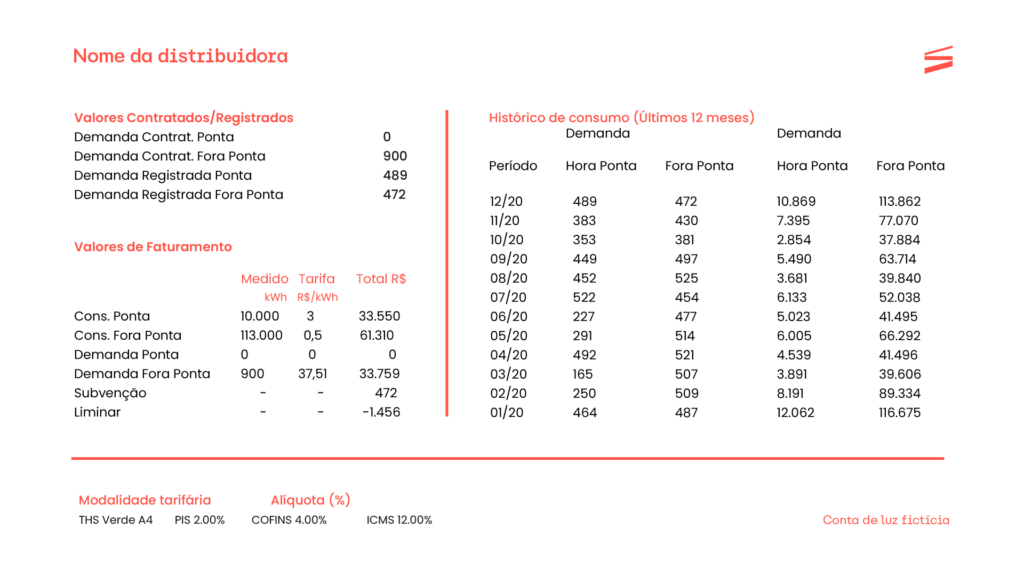
Contracted Demand: with a recent electricity bill in hand, highlight what the contracted demand is. It is measured in kW and is subdivided into peak‑hour and off‑peak contracted demand, a choice that will depend on the company's size;
Tariff modality and voltage level: next, observe the tariff modality and voltage level (they usually appear together).
The voltage level can be at transmission level:
Transmission Network (≥ 230 kV), for consumers directly connected to the so‑called Basic Network;
Or, at distribution level:
A1 (for distributors that still have voltage networks ≥ 230 kV);
A2 (88 to 183 kV);
A3 (69 kV);
A3a (30 to 44 kV);
A4 (2.3 to 25 kV);
AS (< 2.3 kV through underground connection).
Low‑Voltage customers are those connected at voltage below 2.3 kV and fall under other specific tariff rules. High‑ and medium‑voltage customers can have Blue, Green (available for those connected at A3a, A4 and AS voltages, with incentives to reduce or zero network consumption during peak hours) or Conventional tariff modalities.
Used Demand: now, analyze how the demand was used over the months in your consumption history. This information appears in two columns, peak and off‑peak;
Distributor: identify your electricity distributor. It is the entity that receives the amount you pay for your energy, which in turn passes the amounts due to generators, transmitters and the government;
ICMS rate, tax subsidies and injunction: see the ICMS rate paid. It is shown as a percentage and in some states varies according to your business segment. If the state has tax subsidies or the consumer has any injunction, remember to also consider these items when making the calculation;
Consumption: last but not least, analyze your consumption. Like demand, it is also classified as peak and off‑peak, and reported on the bill in MWh or kWh. Important: consumption does not impact the feasibility of migration, but it influences the savings obtained.
With this information and knowing the energy prices in the free market, it is possible to compare costs and calculate the real savings resulting from this migration.
But remember that in the Captive Market there are also tariff flags, which can increase this cost or not. To compare the markets, follow these steps:
Consumption curve analysis
This step is useful for you to see if energy consumption changes according to seasonality. For example, some companies have high demand at the beginning of the year due to summer, while others keep production constant.
This will also help understand how flexible the energy contract needs to be, so that it exactly reflects consumption over a period.
Important: in the Free Energy Market, the contract period and energy volume are chosen by the consumer. Therefore, it is important to know consumption so as not to worry about possible future price fluctuations.
Demand utilization analysis
Here, you need to check whether the contracted demand matches the used demand to discover which energy source will provide the most savings.
Remember that an over‑contracted or under‑contracted demand can lead to wrong choices, so attention is needed in this aspect. If that is the case, consider the adjustment at this stage.
This demand adjustment can mean a lot of savings. See the example to understand better:
Customer profile;
Enel São Paulo distributor;
Voltage level A4;
Green tariff modality;
Contracted demand of 900 kW;
Maximum demand read (in the last 12 months) of 579 kW;
Off‑peak demand tariff (TUSD Off‑peak) of R$ 23.40/kW.
If there is no reason to keep this over‑contracted demand, this is the moment to reduce it. In this case, considering the TUSD Off‑peak value of R$ 23.40/kW, this reduction would result in a savings of R$ 7,447 per month.
Simulation of costs with energy sources
In this step, choosing the most economical energy source is essential. It is the basis for calculating the Energy Cost in the Free Market and the Energy Transmission Cost. Summed together, they allow visualization of energy costs in the Free Energy Market to decide whether migration is worthwhile.
To perform these calculations, besides the data related to the customer profile (listed at the beginning of this section), it is necessary to know the prices of each energy source. They vary daily or even more than once a day.
It is also necessary to know the current distribution tariffs of your distributor (especially the demand TUSD – or wire and TUSD charges) and the applicable rate (PIS/COFINS).
Simulation of monthly costs with CCEE
Another important step is the calculation of costs with CCEE. Although the amount is small representative within the overall energy cost, it must be understood.
It is monthly and the calculation is simple: just multiply the annually defined CCEE tariff by the month‑by‑month consumption. See the example:
Assuming a CCEE tariff of R$ 8.20/MWh;
And a consumption of 84.465 MWh;
Total CCEE costs: R$ 8.20 × 84.465 MWh = R$ 693/month.
Comparison of Costs: Regulated Market vs. Free Energy Market
To finish, it is necessary to consider the calculation of energy cost in the Regulated Market, the cost of energy transportation in the Regulated Market, and also the cost of tariff flags.
The flag surcharge is defined by ANEEL and recalculated annually to adjust to energy cost variations and conditions that may affect electricity distribution agents.
When considering these steps, you should have noticed that in the Free Energy Market the energy costs are managed separately, while in the Regulated Market they are summed up in a single bill.
You also noticed that the markets keep differences between them regarding the types of costs. Some are common to both and others are exclusive to each.
The comparison says a lot about the savings the consumer will have by moving to the Free Energy Market, however, the feasibility analysis is only completed after also considering the contract term with the distributor and the initial entry investments.
Best Migration Date to the Free Energy Market
A consumer in Group A (units supplied at voltage equal to or higher than 2.3 kV) has the following contracts with its distributor in the Regulated Market:
Distribution System Use Contract (CUSD), referring to the TUSD components, and Regulated Energy Commercialization Contract (CCER).
The migration to the Free Energy Market is formalized by sending a termination letter to the distributor which, through recent regulatory improvements, must occur 180 days before the desired date.
The migration is carried out sequentially, without needing to wait for the distributor contract term to end. Migrations in shorter periods can be done at no cost, depending on the distributor, or through payment of a termination penalty.
Total Initial Investments
To migrate to the Free Energy Market and thus save on the electricity bill, some initial investments are also required, namely:
Adaptation of the Measurement System for Billing (SMF)
The Free Energy Market client needs to have the meter connected to the CCEE. The cost of this adaptation can vary, depending on the standards required by the distributor and the situation of the Measurement System for Billing.
This investment can occur before migration or only when becoming an agent in the Free Market.
To get a more accurate estimate of this cost, it is recommended to contact a technical specialist in adaptation. Another option is to access the database with the distributor’s billing history, to consult the average amount invested by customers with a similar consumption profile.
Important: at this stage, the electricity may be turned off for a few hours during business hours to connect the new meter. By choosing Serena Energia as your energy supplier, this cost is not charged to the consumer.
Adherence to CCEE
To participate in the Free Energy Market, it is necessary to join the Electric Energy Commercialization Chamber (CCEE).
This process starts with online filling, on the CCEE website, of some information about the representative and the company, in order to generate the fee invoice.
Once the payment is identified, the adherence process is opened and must be completed within six months.
Regulated Market vs. Free Energy Market Savings ✓
Best migration date ✓
Total initial investments ✓
Done! Now you have all the information to decide and, if positive, start the migration process.
Migration
Migration comprises the process the consumer must go through to become a Free Energy Market consumer. The migration steps are as follows:
Send the termination letter to the distributor
The termination letter is a document in which the consumer declares the intention to migrate to the Free Energy Market and, thus, the desire to terminate its Regulated Energy Purchase Contract (CCER) or not renew the current contract.
The subsequent procedures after sending the letter will be guided by the distributor and involve some documentation that must be filled out or updated.
Start the adherence process with CCEE
In parallel with the migration process started with the distributor, the agent must join the CCEE.
The adherence process includes three steps to be carried out jointly: commercial qualification, opening a checking account at Bradesco Trianon Agency, and technical qualification.
Just as in other parts of the entry process into the Free Energy Market, Serena Energia performs this step in order to simplify the process for the client.
8 – Why Migrate to the Free Energy Market?
Joining the Free Contracting Environment brings several benefits, but attention is required.
It is important to know that migration represents a transformation in the way you manage your electricity costs. You gain the freedom to choose suppliers and negotiate energy contracts, thus optimizing the resources related to this input.
On the other hand, you have the responsibility to purchase and manage the necessary energy. In other words, you must operate in a dynamic market, with specific rules and procedures.
If this energy management is not conducted correctly, you may purchase less energy than needed and end up facing penalties. You may also need to compensate the shortfall by buying on the short‑term market, exposing yourself to higher last‑minute prices.
Some benefits of the Free Energy Market include:
Freedom of Choice: you make the decisions regarding the energy purchase process, being able to choose suppliers and the desired source;
Competitiveness: with competition among marketers and generators, the market becomes more competitive, contributing to increased service efficiency and lower prices;
Flexibility: the entire energy contracting process is freely negotiated between the parties involved through bilateral contracts, without regulator interference;
Predictability: with the contract signed, you gain greater control over your electricity cost, knowing in advance how much you will pay per MWh consumed;
Same energy price during peak and off‑peak hours: in the Regulated Contracting Environment, energy tariffs have higher values during peak consumption periods. In the Free Market this price is uniform at any time;
Free from tariff flags: tariff flags are published monthly by ANEEL. They burden all consumers in the Regulated Market, but do not affect those in the Free Market.
9 – Overview of the Free Energy Market in Brazil and Abroad
The Free Energy Market has been gaining ground in Brazil, year after year.
According to the Brazilian Association of Energy Traders (Abraceel), this contracting environment is already responsible for 83% of the expansion of electricity generation in Brazil up to 2026.
The Brazil is ranked 41st in the International Electricity Freedom Ranking, released in October 2024 by Abraceel. In 2019, Brazil occupied position 55 in the same ranking.
Full market opening could further increase the savings percentage, contributing to the sustainability of countless companies and a significant reduction in the electricity bills of millions of Brazilian consumers.
Free Energy Market Worldwide
The International Electricity Freedom Ranking by Abraceel shows that in 35 countries around the world, all energy consumers are already free.
Among these countries, Japan, Germany, South Korea, France and the United Kingdom occupy the top five positions.
In the United States, 19 of the 50 states have an open energy market for all consumers. In Canada, this is a reality only in the provinces of Ontario and Alberta.
Countries such as Colombia, Guatemala and Mexico are still moving toward market opening.
How Can Serena Help You Migrate to the Free Energy Market?
Now that you know how the Free Energy Market works, you also know that it is important to choose the right energy supplier. Serena Energia reduces your company's electricity bill by up to 30% through clean and affordable energy.
Serena’s billing model is simple and transparent. Here, you only pay for what you consume and secure savings that can last for years.
Do it like Eurofarma, Bayer, Heineken and many other companies that thrive with Serena’s 100% clean energy. Come energize your business with Serena!
See also:
i>
Redação Serena Energia
We are part of Serena, one of the country's leading generators and traders of clean energy, with 15 years of experience connecting people and businesses to sustainable and competitive solutions. Here on the blog, you'll find content on the electricity sector, Free Energy Market, sustainability, and energy transition, with clear explanations to support decisions in your daily life, whether at home or in your business.
Editor
Leave a comment
Your email address will not be published. Required fields are marked with *