
Feasibility study for the free energy market: guide
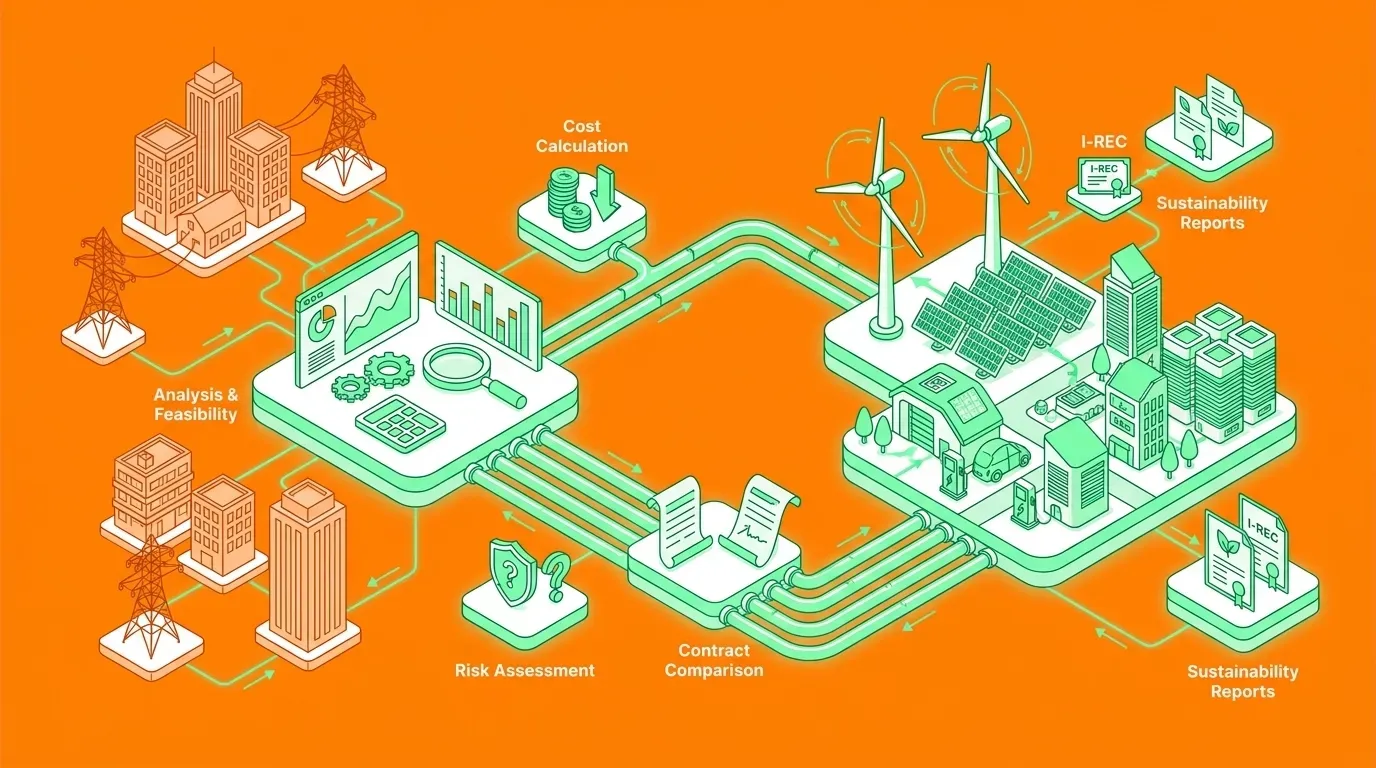
Written by: André Lima, Growth, Serena Energia
Main lessons from this article
-
Group A companies can reduce costs and gain predictability by migrating to the free energy market, provided they conduct a structured feasibility study that considers PLD exposure.
-
The study should quantify net savings, calculate financial exposure under different PLD scenarios, and assess NPV, payback, and VaR to support the decision.
-
Flat contracts offer greater predictability, while PLD-indexed contracts allow capturing low prices but increase exposure. Serena Energia's retail model balances operational simplicity and risk control.
-
Minimum requirements include medium or high voltage connection, hourly metering, and documentation for joining the CCEE (Electric Energy Commercialization Chamber). The regulatory process takes about six months.
-
To obtain a customized feasibility study and full migration support, contact a Serena Energia consultant.
Why conduct a feasibility study before migrating?
Migrating to the free energy market involves long‑term contractual commitments, adaptation of the metering system, and joining the CCEE (Electric Energy Commercialization Chamber). A decision without quantitative analysis can generate financial exposure greater than the projected savings, especially during periods of high PLD.
Data from Abraceel show that the average PLD rose 84% between 2024 and 2026, moving from R$ 129/MWh to R$ 236/MWh. In the same period, short‑term contracts recorded significant increases. This context reinforces the need to model scenarios before signing any contract.
The feasibility study answers three central points: what is the expected net savings compared to the captive market, what is the financial exposure to PLD in case of consumption deviation, and which type of contract balances predictability and cost for the company's profile.
Talk to the Serena Energia team to understand how the company conducts this process at no additional cost for clients under its management.
Essential concepts to understand the migration
In the captive market, the company purchases energy from the local distributor at rates regulated by ANEEL, which include the Energy Tariff (TE), the Distribution System Use Tariff (TUSD), and tariff flag charges. In the free energy market, the company negotiates directly with a supplier—who can be a generator or a marketer—the price, volume, and contract term. The local distributor remains responsible for the physical delivery of electricity, and the only change is the agent selling the energy.

The PLD is the price calculated by the CCEE (Electric Energy Commercialization Chamber) to financially settle the differences between the contracted volume and the volume actually consumed by each agent. If a company consumes more than contracted, it purchases the excess at the prevailing PLD, and if it consumes less, it sells the surplus at the PLD. The larger the deviation and the higher the PLD, the greater the financial impact.
Contracts in the free energy market are mainly divided into two models:
-
Flat contract (fixed price): sets the price per MWh at signing and maintains that value throughout the entire term, regardless of PLD fluctuations.
-
PLD-indexed contract: ties the price to the weekly PLD calculated by the CCEE (Electric Energy Commercialization Chamber), with lower costs in favorable periods and higher costs during hydrological stress or thermal dispatch.
The I‑RECs (International Renewable Energy Certificates) are certificates that verify the renewable origin of each MWh consumed and have become central instruments for sustainability reporting and Scope 2 emissions‑reduction targets.
Clarify doubts about contracts and certificates with Serena Energia before making any decision.
Step‑by‑step feasibility study
With the fundamental concepts established, the next step is to translate the company's consumption profile into a quantitative viability analysis. The study follows four main stages.
1. Collection and analysis of consumption history
Gathering invoices from the last 24 to 60 months allows mapping monthly consumption in MWh, contracted demand in kW, seasonality, and peaks. This history defines the volume to be contracted in the free energy market and the degree of flexibility needed in the contract.
2. Calculation of current cost in the captive market
Add up all components of the current invoice: TE (Energy Tariff), TUSD (Distribution System Use Tariff), sectoral charges, and tariff flags. This total represents the monthly cost in the captive market and serves as the baseline to measure potential savings in the free market. Any cost reduction will be calculated relative to this number.
3. Projection of cost in the free energy market by PLD scenario
The total cost in the free market results from the combination of the contracted price and PLD exposure on the volume not covered by the contract. The financial exposure formula is:
Financial exposure = (Actual consumption − Contracted volume) × PLD
A negative result indicates a need to purchase the deficit at the PLD, and a positive result indicates selling the surplus at the PLD. To understand the real financial impact of this exposure, consider a company with a monthly consumption of 500 MWh and a contracted volume of 475 MWh, resulting in a 25 MWh deviation (5%). The table below shows how the exposure cost varies across four PLD scenarios, from favorable conditions to extreme peaks:
|
PLD Scenario (R$/MWh) |
Exposure (MWh) |
Exposure cost (R$) |
Market reference |
|---|---|---|---|
|
80 |
25 |
R$ 2.000 |
High hydraulicity scenario |
|
180 |
25 |
R$ 4.500 |
Near the 2024 average (R$ 129/MWh) |
|
450 |
25 |
R$ 11.250 |
Intermediate stress scenario |
|
900 |
25 |
R$ 22.500 |
Extreme peak scenario, the PLD in the Southeast subsystem reached a maximum of R$ 277.39/MWh in January 2026 |
These four PLD exposure scenarios form the basis for projecting the company's monthly cash flows in the free energy market. Each scenario generates a series of monthly costs, combining the contracted price and PLD exposure, and these costs are compared to the captive‑market monthly cost to calculate net savings for each month.
4. Calculation of NPV, payback and VaR
With these projected cash flows for each scenario, calculate:
-
NPV (Net Present Value): discount the net‑savings cash flows, obtained by the difference between captive cost and free‑market cost, using the company's discount rate. A positive NPV in all scenarios indicates robust viability.
-
Payback: number of months until accumulated savings exceed the adaptation costs, such as metering and CCEE (Electric Energy Commercialization Chamber) joining.
-
VaR (Value at Risk): based on the CVaR calibration used in PLD pricing models, estimate the maximum expected loss at a confidence percentile, typically 95%, for the contract horizon. This figure defines the acceptable exposure limit for the company.
Request from Serena Energia the complete modeling of NPV, payback and VaR for your company's consumption profile.
Comparison between flat contract and PLD‑indexed contract
The choice of contract type directly determines budget predictability and PLD exposure. The main trade‑off is between greater cost stability in flat contracts and higher sensitivity to PLD in indexed contracts. The table below shows how each model performs across five decisive criteria.
|
Criterion |
Flat contract (fixed price) |
PLD‑indexed contract |
Serena Energia retail model |
|---|---|---|---|
|
Budget predictability |
High, with a fixed price per MWh throughout the term |
Low, with cost varying weekly with the PLD |
High, with a fixed price in the contract and invoice calculated on actual consumption |
|
PLD exposure |
Limited to consumption deviations outside the contractual range |
Full, with all consumed volume priced at the PLD |
Limited to 5–10% of contracted volume, corresponding to the flexibility range |
|
Cost in low PLD |
Includes a premium |
security above the spot PLD
Captures the low price in full
Follows the contracted price, without capturing spot variations
Cost in high PLD
Remains limited to the contracted fixed price
Directly reflects the increase in PLD, which showed significant variations in 2026
Remains protected within the contracted volume
Recommended profile
Companies that prioritize OPEX predictability
Companies with high tolerance to cost fluctuations and active management
Companies seeking operational simplicity and predictability
In Serena Energia's retail model, the client does not purchase a specific volume of energy, but locks in the price per MWh, and the monthly invoice is calculated by multiplying this price by the actual consumption. Exposure to PLD is limited to the contractual flexibility range, typically between 5% and 10% of the reference volume.
Talk to Serena Energia's energy consulting team to assess which contractual model best fits your company's consumption profile and risk level.
Minimum requirements and typical migration steps
Verifying that the company meets the basic requirements avoids rework and delays in the migration schedule.
-
Connection at medium or high voltage, Group A.
-
Measurement system compatible with the free electricity market, with mandatory hourly measurement.
-
Technical, legal and financial documentation for joining the CCEE (Electric Energy Commercialization Chamber).
The migration process usually follows these steps:
-
Conduct feasibility study and select the supplier.
-
Sign the supply contract, generally for 3 to 5 years.
-
Notify the local distributor to terminate the captive contract.
-
Adapt the measurement system (SMF), carried out by Serena Energia, as mentioned.
-
Register and join the CCEE (Electric Energy Commercialization Chamber), also carried out by Serena Energia.
-
Start supply in the free electricity market, after the regulatory period of approximately six months.
Start the migration process with Serena Energia's team support and reduce internal operational load.
What changes after migration: operation and continuous management
After migration, the company receives two monthly invoices, one for the contracted energy, issued by the supplier, and another for the use of the distribution network, issued by the local distributor. Serena Energia centralizes the management of these obligations for its managed clients and can even handle payment to the distributor.
Continuous management includes:
-
Monthly monitoring of actual consumption against the contractual reference volume.
-
Digital dashboard with monthly savings, accumulated consolidated savings, consumption forecast and comparison between captive and free electricity markets.
-
Representation before the CCEE (Electric Energy Commercialization Chamber) in the retail model, with settlement management and sectoral compliance.
-
Issuance of I-RECs corresponding to consumption, for use in sustainability reports and Scope 2 verification.
Explore Serena Energia's energy management dashboard and see how to track results in real time.
Common risks and best mitigation practices
The main risks in operating in the free electricity market can be controlled with proper monitoring and governance.
-
Volume misalignment: consumption systematically above or below the reference volume generates PLD exposure. Mitigation involves monthly monitoring and adjusting the contractual profile when necessary.
-
PLD volatility: significant intraday variations were observed in 2026, making hourly consumption profile analysis indispensable for indexed contracts.
-
Regulatory complexity: settlements, financial guarantee contributions and obligations to the CCEE (Electric Energy Commercialization Chamber) require sector expertise. The calculation of the financial guarantee contribution considers the agent's estimated net exposure, PLD volatility and other factors defined in the CCEE Commercialization Procedures.
The most effective mitigation for Group A companies that do not have energy as a core business is active management by an experienced marketer, who assumes regulatory obligations and continuously monitors consumption.
Understand with Serena Energia how to structure this risk management for your business.
Decision criteria summary
A well‑structured feasibility study must meet all the criteria below before recommending migration.
-
The NPV of net savings remains positive even in the scenario of the highest modeled PLD.
-
The maximum financial exposure, calculated by the product of deviation and peak PLD, is compatible with the company's cash flow.
-
The chosen contract type—flat, indexed or retail—is aligned with risk appetite and budgeting predictability needs.
-
The supplier demonstrates own generation capacity and financial solidity to honor the contract throughout its term.
-
Post‑migration management, which includes measurement, relationship with the CCEE (Electric Energy Commercialization Chamber) and invoicing, is covered without operational overload for the internal team.
Serena Energia, one of the largest wind and solar generators in the Americas, offers managed migration, energy consulting and continuous management at no additional cost for clients under its management. With more than 17 years of history and clients such as Heineken, Cargill and Bayer, the company combines own generation and a digital platform to deliver savings, predictability and sustainability in a single contract.

Take the first step toward a complete feasibility study with Serena Energia, with PLD scenarios, exposure analysis and savings projection for your company.
Frequently asked questions
Does my Group A company need a minimum consumption to migrate to the free electricity market?
There is no minimum consumption. Any company connected at medium or high voltage, the so‑called Group A, can migrate to the free electricity market, regardless of monthly volume consumed. Economic viability depends on consumption profile analysis, the most suitable contract type and PLD exposure, not on a minimum kWh threshold.
What happens if my company consumes more or less than the contractual reference volume?
Contracts in the free electricity market provide a flexibility range, usually between 5% and 10% of the reference volume. Consumption within this range does not generate additional exposure. Outside it, the difference is financially settled by the CCEE (Electric Energy Commercialization Chamber) at the prevailing PLD for the period. In Serena Energia's retail model, the client locks the price per MWh and the invoice is calculated on actual consumption, simplifying deviation control. Active consumption management and monthly monitoring are the main tools to reduce this exposure.
How long does the migration process take and what steps does my team need to conduct?
The process takes the regulatory period mentioned earlier, six months, determined by the prior notice required by the distributor to terminate the captive contract. For clients under Serena Energia's management, the entire journey—including distributor notification, measurement system adaptation, CCEE registration and technical and legal documentation—is carried out by Serena Energia's team, maintaining the previously described no‑additional‑cost model. The company's internal team does not need to assume regulatory responsibilities during the process.
How is the I‑REC issued and what is it used for in sustainability reports?
The I‑REC (International Renewable Energy Certificate) is a traceable digital certificate that proves that 1 MWh of energy was generated by a renewable source and injected into the grid. For each MWh consumed, Serena Energia can issue the corresponding I‑REC, which is globally recognized and used to demonstrate 100 % renewable energy consumption in sustainability reports, Scope 2 emission inventories and stakeholder and investor requirements. This certificate is the standard instrument for companies that need to auditable demonstrate commitment to decarbonization goals.
What is the practical difference between contracting energy in the retail model and the wholesale model?
In the wholesale model, the company acts directly as an agent in the CCEE (Electric Energy Commercialization Chamber), managing its own contracts, financial guarantee contributions and short‑term market settlements. This model requires a dedicated internal structure and is more suitable for large consumers with specialized teams. In the retail model, a marketer like Serena Energia intermediates the entire process: the client locks the price per MWh, receives two monthly invoices—for energy and for distribution—and has a dedicated consultant for monitoring and support. Regulatory complexity stays entirely with the marketer, at no additional cost for the client under Serena Energia's management.

André Lima
We are part of Serena, one of the country's leading generators and traders of clean energy, with 15 years of experience connecting people and businesses to sustainable and competitive solutions. Here on the blog, you'll find content on the electricity sector, Free Energy Market, sustainability, and energy transition, with clear explanations to support decisions in your daily life, whether at home or in your business.
Editor
Leave a comment
Your email address will not be published. Required fields are marked with *